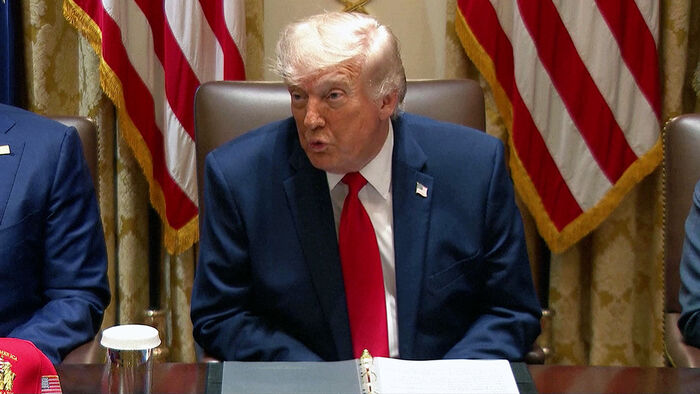
▲ President Trump
Although the United States and Iran have announced an agreement to end the war, differences in their positions are emerging over key issues, including the reopening of the Strait of Hormuz.
While the signing of a memorandum of understanding (MOU) scheduled for June 19, local time, has bought 60 days for follow-up negotiations, concerns are rising that these differences in positions could remain a trigger and potentially reignite physical conflict.
For now, what both the U.S. and Iran commonly agree on is that as soon as the end-of-war MOU is signed, the Strait of Hormuz will be reopened and the U.S. blockade against Iran will be lifted.
The issue is whether merchant ships will be able to pass freely through the Strait of Hormuz without paying separate fees, as they did before the war.
U.S. President Donald Trump, after announcing the agreement to end the war on June 15, stated in an interview with The New York Times (NYT) that tolls in the Strait of Hormuz would ultimately be permanently waived.
This is interpreted to mean that once the strait opens with the signing of the MOU on June 19, conditions will return to the pre-war era when there were no tolls.
However, Iran's semi-official Fars News Agency reported that Iran's right to collect transit fees for the Strait of Hormuz has been recognized.
The report claims that since the final draft of the MOU specifies a clause stating "the future management of maritime navigation services in the Strait of Hormuz will be decided by Iran and Oman," the U.S. has officially recognized Iran's collection of fees under the pretext of providing maritime services.
Fars News Agency added that Iran plans to allow free passage for ships only for the next 60 days.
This suggests that if nuclear negotiations with the U.S. proceed as scheduled for 60 days and a final agreement is reached, Iran will be able to collect fees in exchange for providing services related to safe navigation in the Strait of Hormuz thereafter.
While President Trump uses the term "tolls" and Iran uses "fees," if Iran collects charges in any form from ships passing through the strait, it means the Strait of Hormuz will effectively become a toll-based waterway following the war.
Since Iran has explained that the end-of-war MOU will be made public upon signing, it is difficult to confirm what final wording was included in the document.
However, the NYT also reported that "the MOU is set to suspend tolls for only 60 days, after which regional discussions will take place."
This foreshadows a rough road ahead not only for the implementation of the MOU but also for the nuclear negotiations to be held over the next 60 days.
The differences in positions between the two sides are also clearly emerging regarding the issue of releasing frozen assets immediately following the announcement of the agreement.
Iran maintains the position that a portion of the frozen assets must be released simultaneously with the signing of the MOU.
Kazem Gharibabadi, Iran's Deputy Foreign Minister, mentioned the lifting of the maritime blockade, the termination of military operations, and the release of frozen assets, stating that the 60-day negotiations following the MOU signing depend on the U.S. fulfilling these three promises.
Iran's frozen assets are estimated to be around $100 billion.
Iranian media have floated a plan to release $12 billion upon the signing of the MOU and another $12 billion during the 60-day negotiation period.
The U.S., however, immediately made it clear that it cannot release the frozen assets in conjunction with the signing of the MOU.
A U.S. government official dismissed the possibility to CNN, stating that the frozen assets will not be released unless Iran fulfills its promises.
The U.S. wants to align sanctions relief with halting Iran's nuclear development, which it has cited as the primary reason for the war.
This would involve providing economic rewards, such as sanctions relief, depending on the scope of Iran's nuclear abandonment and its implementation.
Concerns are being raised that if Iran persists in its demand for the immediate release of frozen assets and the U.S. refuses, the implementation of the MOU could face hurdles from the very beginning.
Because the nuclear negotiations following the MOU signing are piled with major issues where narrowing differences in a short time will be difficult, some evaluate this MOU as nothing more than a temporary 60-day extension of the truce.
※ Please note: This article was translated by AI and may contain errors.