[Anchor]
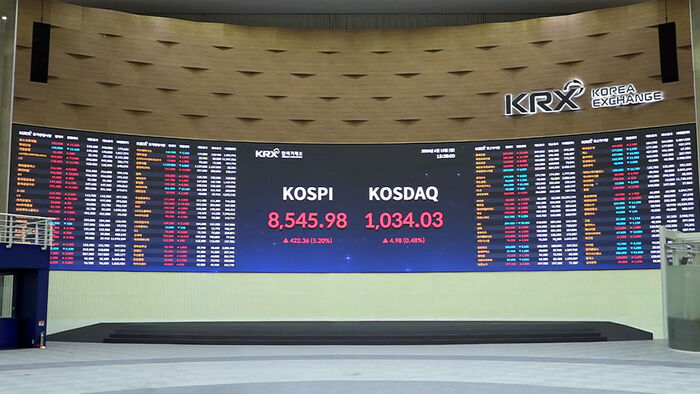
The KOSPI also jumped more than 5% yesterday (June 15). While the exchange rate has dipped for now, voices remain cautious, suggesting it is too early to tell if soaring inflation will be brought under control.
Reporter Jeong Jun-ho has the story.
[Reporter]
The KOSPI soared immediately upon opening, triggering a "buy sidecar" just six minutes into the trading session.
Investor sentiment improved following news of a ceasefire agreement between the United States and Iran, and foreign investors continued their net buying for the second consecutive trading day, driving the index higher.
The KOSPI closed at 8,545, up 5.2% from last Friday.
Samsung Electronics and SK Hynix led the market, rising more than 4% and 6% respectively. Airline stocks, including Korean Air and Jeju Air, recorded double-digit gains as international oil prices fell to the low $80 range per barrel.
The won-dollar exchange rate also fell, bolstered by the ceasefire agreement and net buying by foreign investors.
It closed the daily session at 1,511 won, down 8.7 won.
While the decline in international oil prices and the exchange rate offers some relief, concerns over inflation persist.
Because a significant portion of crude oil production facilities was destroyed during the war, it will inevitably take time for international oil prices to return to pre-war levels.
Some forecasts suggest that oil prices could remain at $85 in the second quarter and stay as high as $90 by the fourth quarter of next year.
[Interview: Cho Young-moo / Director at NH Financial Research Institute: It may take time for costs such as insurance premiums or freight rates to fall again, and it does not seem easy for (oil prices) to return to levels seen before the Iran war.]
Furthermore, there is a time lag before the drop in international oil prices is reflected in domestic fuel prices, and there is a high possibility that the energy prices that have risen so far will impact inflation with a delay.
Even though the exchange rate has fallen, it remains at a high level, which, along with oil prices, could continue to act as upward pressure on inflation.
[Interview: Heo Jun-young / Professor of Economics at Sogang University: With the possibility of U.S. interest rate hikes still remaining, it does not seem like the strong dollar will disappear suddenly. The mechanical buying or selling (by foreign investors) still remains.]
Given the persistent inflation concerns, experts predict that the Bank of Korea will proceed with interest rate hikes in the second half of this year as previously signaled.
Reported by Jeong Jun-ho | Video by Jeong Yong-hwa | Graphics by Jo Su-in
※ Please note: This article was translated by AI and may contain errors.
KOSPI Surges Over 5% on Hopes for End of War; Inflationary Pressures Persist
Jun 16, 2026