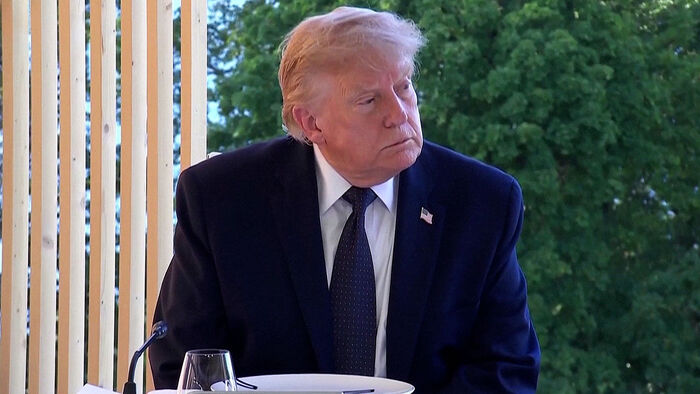
▲ U.S. President Donald Trump
The Donald Trump administration in the United States is reportedly considering a plan to establish a reconstruction fund worth $300 billion (approximately 454 trillion won), centered on private companies, if Iran agrees to a final peace agreement that includes nuclear negotiations.
While the U.S. has emphasized its stance of not providing funds to Iran in exchange for an agreement, practical financial support would effectively be provided under the guise of a private investment fund.
In Iran, some are claiming that this fund constitutes war reparations from the United States.
The Financial Times (FT) reported on June 15 (local time), citing a senior U.S. official, that easing sanctions on Iran and creating a $300 billion reconstruction fund were discussed during the peace negotiations.
U.S. Vice President J.D. Vance also virtually acknowledged the discussions on creating the reconstruction fund during an interview with CBS, saying, "If Iran fulfills its obligations, they will have access to it."
The FT, citing a source familiar with the discussions, reported that the reconstruction fund would only be established once a final agreement, in which the fund is specified as part of a Memorandum of Understanding (MOU), is reached.
Under the MOU, the U.S. and Iran agreed to first open the Strait of Hormuz and then continue negotiations toward a final agreement on issues such as Iran's nuclear program and the easing of sanctions against Iran.
This means that if the fund is ultimately created, it will be after the Strait of Hormuz is normalized, the nuclear agreement is finalized, and an ultimate end to the conflict is reached.
The FT reported that the fund would be established not by governments, but by companies wishing to invest in Iran's energy industry, adding that the fund's operational structure remains unclear.
A source familiar with the negotiations told the FT, "Companies from Europe, Asia, South Korea, and Japan, as well as U.S. firms, are interested," adding, "If sanctions are lifted, this fund will be of a substantial size."
Whether the U.S. is funding Iran in exchange for ending the conflict has been a point of controversy throughout the negotiation process.
This is a politically sensitive issue, especially since President Trump has previously criticized the Iran nuclear deal (Joint Comprehensive Plan of Action, or JCPOA) signed under former President Barack Obama, pointing out that cash payments were made.
President Trump has been extremely reluctant to make it appear as though compensation is being provided to Iran, consistently emphasizing that "it is different from the Obama era" and "no money is changing hands this time."
However, some point out that the financial incentives currently under discussion could exceed the levels agreed upon during the Obama administration.
The FT, citing sources familiar with the discussions, reported that under the MOU, the lifting of any sanctions, including frozen Iranian assets abroad, would occur in phases, depending on progress in nuclear negotiations and a final agreement.
U.S. officials also explained that small-scale financial relief would be provided in the early stages as a trust-building measure, with further phased relief measures implemented depending on the progress of future negotiations.
A senior official told the FT, "Sanctions relief is absolutely not linked to any specific action," adding, "It is generally linked to whether Iran behaves appropriately, and what we care about most is the nuclear program."
Previously, Iran also mentioned the $300 billion reconstruction fund being established by the U.S. when sharing details of the MOU with the United States.
Mehdi Mohammadi, strategic advisor to the chief advisor of the Iranian negotiating team, claimed the previous day through Iran's Mehr News Agency that the reconstruction fund has the character of war reparations.
He said, "Although the word 'compensation' is not explicitly mentioned, when the other side talks about reconstruction, it is clear that it means compensation for the damage Iran suffered during the war."
※ Please note: This article was translated by AI and may contain errors.