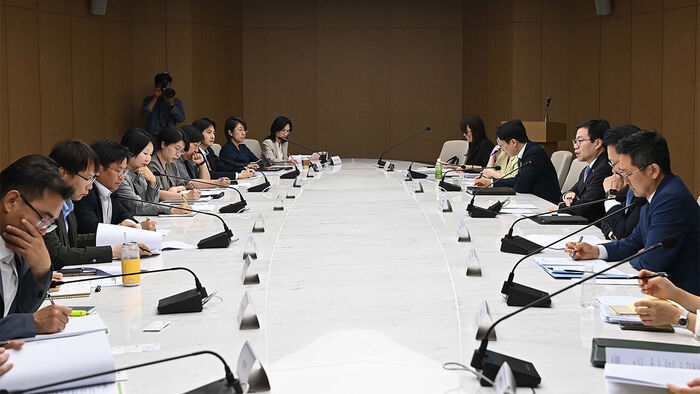
▲ Yeo Han-koo, Minister for Trade at the Ministry of Trade, Industry and Energy, speaks at the 56th Trade Promotion Committee meeting held at the Korea Chamber of Commerce and Industry in Jung-gu, Seoul, on May 18.
As the Donald Trump administration in the U.S. prepares alternative measures to impose tariffs under Section 301 of the Trade Act ahead of the expiration of global tariffs, the South Korean government has held an interagency meeting to discuss response strategies.
The Ministry of Trade, Industry and Energy (MOTIE) announced that it held the 57th Trade Promotion Committee meeting today (June 16) at the Korea Chamber of Commerce and Industry in Seoul, presided over by Minister for Trade Yeo Han-koo, to discuss the current status of the U.S. Section 301 investigation and response plans.
In addition to the Ministry of Trade, Industry and Energy, which is in charge of trade affairs, officials from the Ministry of Economy and Finance, the Ministry of Foreign Affairs, the Office for Government Policy Coordination, the Ministry of Agriculture, Food and Rural Affairs, the Ministry of Land, Infrastructure and Transport, the Ministry of Science and ICT, the Ministry of Employment and Labor, the Ministry of Climate, Environment and Energy, the Ministry of Health and Welfare, the Ministry of SMEs and Startups, the Ministry of Justice, the Korea Customs Service, the Ministry of Food and Drug Safety, the Financial Services Commission, and the Korea Fair Trade Commission attended the meeting.
Minister Yeo explained the progress of the Section 301 investigation recently announced by the U.S. regarding the import ban on products made with forced labor, the details of the U.S. announcement, and the progress of related consultations with the U.S., and discussed subsequent procedures and response plans.
Previously, the Office of the United States Trade Representative (USTR) announced on June 3 that it plans to impose tariffs of 10% to 12.5% on 60 economies on the grounds that they did not block the import of products made with forced labor.
A tariff of 12.5% was applied to 46 economies, including South Korea, while 10% was applied to the other 14 economies.
This measure is scheduled to be finalized after follow-up procedures.
The USTR is also conducting an investigation into overproduction under Section 301 of the Trade Act, and South Korea is also among the target countries.
In February, after the U.S. Supreme Court ruled that the imposition of reciprocal tariffs based on the International Emergency Economic Powers Act was illegal, President Trump imposed a 10% global tariff on countries around the world under Section 122 of the Trade Act.
As the 10% global tariff is a temporary measure effective for only 150 days until late July, the Trump administration intends to fill the gap in reciprocal tariffs by introducing new tariffs following investigations under Section 301 of the Trade Act during this period.
(Photo: Provided by the Ministry of Trade, Industry and Energy, Yonhap News)
※ Please note: This article was translated by AI and may contain errors.