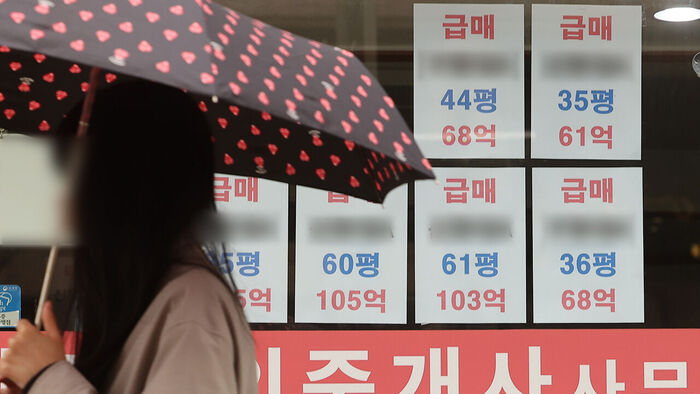
▲ In front of a real estate agency in Seoul
The ratio of household debt to nominal gross domestic product (GDP) in South Korea fell to its lowest level in six years and three months as of the end of last year.
The government debt-to-GDP ratio also saw an unusually sharp decline.
According to the Bank for International Settlements (BIS), South Korea's household debt-to-GDP ratio stood at 88.6% at the end of last year, down 0.8 percentage points (p) from the end of the previous quarter.
This is the lowest level since the end of the third quarter of 2019 (88.3%).
The household debt-to-GDP ratio peaked at 99.1% at the end of the third quarter of 2021, then gradually declined to fall below 90% at 89.6% by the end of 2024.
It remained relatively stagnant at 89.5% at the end of the first quarter of last year, 89.7% at the end of the second quarter, and 89.4% at the end of the third quarter, before dropping significantly to 88.6% at the end of the fourth quarter.
Analysts attribute this result to a combination of factors, including the growth of nominal GDP, the financial authorities' strengthened management of household debt, and lending restrictions in the financial sector.
As the high growth trend continues—with the nominal GDP growth rate in the first quarter of this year reaching 17.1% compared to the same period last year, the highest since the third quarter of 1995 (19.2%)—the household debt-to-GDP ratio is expected to decline further in the future.
The Bank of Korea and financial authorities have previously set a mid-to-long-term goal of lowering this ratio to below 80%.
Meanwhile, South Korea's government debt-to-GDP ratio dropped sharply by 2.0 percentage points in just three months, from 47.7% at the end of the third quarter of last year to 45.7%.
This is the first time in history that this ratio has fallen by 2.0 percentage points at once.
The government debt ratio had reached an all-time high of 47.8% at the end of the second quarter of last year due to the government's expansionary fiscal stance, but it slowed to 47.7% at the end of the third quarter before falling significantly at the end of the fourth quarter.
However, it remains more than 2.0 percentage points higher than the level at the end of 2024 (43.6%).
The prevailing view is that this ratio will also decline further as nominal GDP surges.
In this regard, Bank of Korea Governor Shin Hyun-song stated at a BOK international conference on the 1st, "Nominal GDP growth is expected to be very high," adding, "This will also have a significantly beneficial effect on the household debt-to-GDP ratio and the public debt-to-GDP ratio."
(Photo: Yonhap News)
※ Please note: This article was translated by AI and may contain errors.