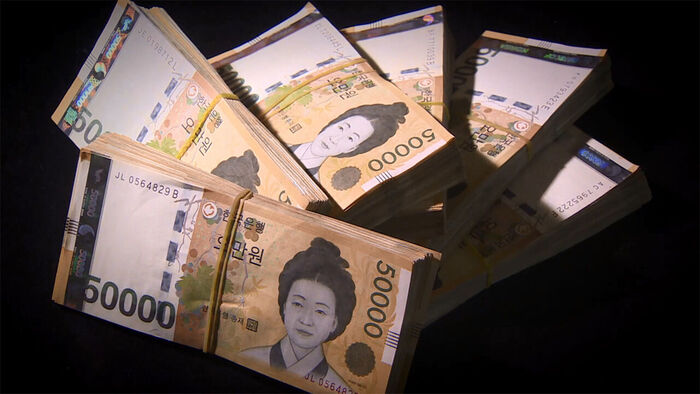
▲ Currency
The money supply increased by over 25 trillion won in April, primarily driven by corporate deposits and short-term financial products.
According to the "Money and Liquidity" statistics released by the Bank of Korea on June 16, the average broad money supply (M2) in April reached 4,153.9 trillion won, an increase of 25.3 trillion won (0.6%) from the previous month.
This marks the largest increase since January (27.7 trillion won) and continues a six-month upward trend that began in November of last year.
M2, a broad measure of the money supply, includes cash, demand deposits, and savings deposits (M1), as well as short-term financial instruments that can be easily converted into cash, such as Money Market Funds (MMF), time deposits and installment savings with maturities of less than two years, Certificates of Deposit (CD), Repurchase Agreements (RP), financial bonds with maturities of less than two years, and money trusts with maturities of less than two years.
Among these, time deposits and installment savings with maturities of less than two years increased by 13 trillion won over the month.
This is the largest increase since the same period last year, when demand for deposits surged by over 15 trillion won ahead of a base interest rate cut.
The Bank of Korea explained that this shifted from a 1.4 trillion won decrease in the previous month to an increase, largely due to a rise in deposits from semiconductor companies.
Other monetary financial products, which include Cash Management Accounts (CMA), foreign currency deposits, and issued bills, increased by 8.3 trillion won, influenced by the inflow of funds waiting for stock market investment.
By economic sector, deposits increased for non-financial corporations (+16.1 trillion won), households and non-profit organizations (+7 trillion won), and social security organizations and local governments (+100 billion won), while deposits from other financial institutions decreased by 600 billion won.
M1, a narrow measure of the money supply that includes only cash, demand deposits, and savings deposits, also increased by 0.4% (6 trillion won) from the previous month to 1,371.5 trillion won.
Meanwhile, the Bank of Korea reviewed whether to include the Investment Management Account (IMA) of comprehensive financial investment business entities, first issued in December last year, in its money and liquidity indicators, and decided to reflect it in the Financial Institution Liquidity (Lf).
The Bank of Korea explained, "IMAs often have closed structures that limit early withdrawal and carry the possibility of principal loss upon early termination, making them difficult to recognize as currency," adding, "However, they align with the nature of Financial Institution Liquidity in that they are products that can be liquidated through redemption or termination based on contracts with financial institutions."
Accordingly, starting with this statistical release, IMAs have been reflected in the Financial Institution Liquidity, with retroactive application applied from December of last year, when IMAs were first issued.
The balance (average balance) of IMAs in April was 2.9 trillion won, and the average Financial Institution Liquidity was 6,219.3 trillion won.
(Photo: Yonhap News TV screen capture, Yonhap News)
※ Please note: This article was translated by AI and may contain errors.