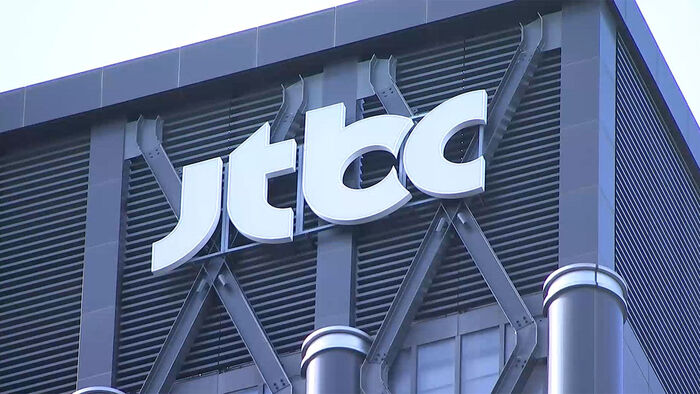
In a report released today (June 16), NICE Credit Rating stated, "On June 12, JTBC defaulted after failing to repay a total of 20.6 billion won in debt. On June 14, four affiliates—JoongAng Holdings, JoongAng P&I, Megabox JoongAng, and Contentree JoongAng—applied for the commencement of rehabilitation proceedings, and on June 15, JTBC also filed for rehabilitation."
Credit exposure refers to the scale of credit, such as loans, provided by financial institutions like banks to a specific counterparty (borrower).
The financial sector's credit exposure to eight JoongAng Group companies, including the five that filed for rehabilitation, as well as JoongAng Ilbo, SLL JoongAng, and JoongAng Ilbo M&P, was found to be approximately 1.3 trillion won.
By financial sector, the banking sector accounted for the largest share at 832.9 billion won, followed by specialized financial institutions at 164.2 billion won, the securities industry at 125.1 billion won, and specialized credit finance companies at 79.7 billion won.
Among individual financial companies, Hanyang Securities had the largest exposure relative to its total assets and capital.
Hanyang Securities' actual book exposure related to JoongAng Group affiliates was found to be approximately 84 billion won.
As of the end of March, Hanyang Securities' equity capital stood at 647.8 billion won.
Its exposure by company was 54 billion won for JTBC and 30 billion won for JoongAng Ilbo.
Of this, the exposure related to JTBC consisted of 18 billion won related to the special purpose company (SPC) 'HY Athens Second' and 36 billion won in commercial paper.
NICE Credit Rating projected, "As the primary debtor, JTBC, has applied for the commencement of rehabilitation proceedings, a decline in asset quality and an increased burden of setting aside provisions related to JTBC bonds (54 billion won) are expected in the future," adding, "The scale of recognized losses will be determined by whether specific tranches reach maturity, the progress of the rehabilitation proceedings, and the recoverability of the claims."
However, it noted, "It has been confirmed that collateral has been established for Hanyang Securities' related exposure," adding, "The collateral assets are managed under a trust structure, and consent for collateral transfer has also been secured from the primary counterparty."
It further pointed out, "The existence of these collateral assets supplements the recoverability of claims related to JTBC and JoongAng Ilbo, and is evaluated as a factor that partially mitigates the negative impact of the related exposure on Hanyang Securities' creditworthiness."
NICE Credit Rating stated, "Regarding Hanyang Securities' creditworthiness, we plan to focus on monitoring the cash-generating capacity of the collateral assets and the recovery level of the related claims."

▲ Hong Jeong-do, Vice Chairman of JoongAng Group
Another credit rating agency, Korea Ratings, judged that due to prolonged sluggish performance accumulated since 2020, the total borrowings of major JoongAng Group affiliates reached 3 trillion won at the end of last year, making it difficult to improve their financial structure through self-rescue measures alone.
In its report, Korea Ratings analyzed, "While broadcast advertising revenue, the core revenue base of media affiliates such as JoongAng Ilbo and JTBC, showed a structural decline, Megabox JoongAng struggled to improve profitability due to the slump in the movie theater industry following the COVID-19 pandemic and changes in content consumption patterns centered on over-the-top (OTT) services, and SLL JoongAng faced difficulties due to rising content production costs and sluggish performance of overseas subsidiaries."
Consequently, borrowing burdens steadily accumulated due to free cash flow deficits. In particular, the level of financial risk linkage within the group rose rapidly as they responded to funding shortages not only through direct short-term financial support among affiliates but also by issuing asset-backed securities based on credit provision.
Korea Ratings pointed out, "The simultaneous applications for corporate rehabilitation by these affiliates prove that the financial burden across the entire group has exceeded manageable levels, reaching a point where funding conditions and liquidity response capabilities have significantly deteriorated."
It further evaluated, "Even for affiliates that have not applied for corporate rehabilitation, it is difficult to rule out the possibility of additional credit events, such as non-repayment of financial institution borrowings or the initiation of debt restructuring."
Therefore, it said, "Intensive monitoring is required in the future on whether they can respond to short-term repayment burdens, such as refinancing short-term borrowings, including market borrowings and financial institution credit."
※ Please note: This article was translated by AI and may contain errors.