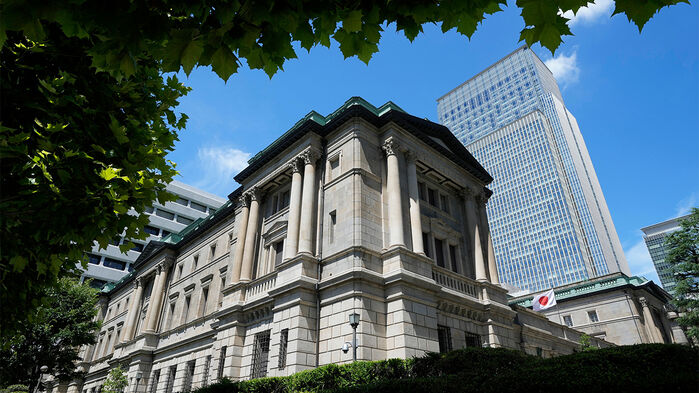
▲ Bank of Japan
The Bank of Japan (BOJ) raised its benchmark policy interest rate by 0.25 percentage points from the previous "around 0.75% per year" to "around 1.0%" at its monetary policy meeting today (June 16).
Attention is focused on the impact on the market as Japan's interest rate has been raised to its highest level in about 31 years since 1995.
Japan's benchmark interest rate had not exceeded 0.5% since it was lowered from 1.75% to 1.0% in April 1995 and further adjusted downward from 1.0% to 0.5% in September of the same year. Since 2016, the BOJ had maintained a negative interest rate policy, charging a storage fee to financial institutions depositing surplus funds.
Since the inauguration of Governor Kazuo Ueda, who advocated for ending ultra-low interest rates and normalizing monetary policy, the Bank of Japan has taken steps starting with ending its negative interest rate policy in March 2024. It raised the benchmark rate from 0 to 0.1% to 0.25% in July of the same year, to 0.5% in January last year, and then to 0.75% last December.
Following a period of catching its breath, the decisive factor behind this rate hike—the first in six months—was the high oil prices triggered by the U.S.-Iran war, which dealt a critical blow to the Japanese economy, which relies on the Middle East for more than 90% of its crude oil.
Excluding the effect of the Japanese government's electricity and gas subsidy support, the Consumer Price Index (CPI) in April rose 2.8% year-on-year, spreading concerns that high oil prices would also drive up the core inflation rate.
Last month's Corporate Goods Price Index (preliminary figure) jumped 6.3% year-on-year, reaching its highest level in three years and two months since March 2023. This also appears to have been a factor in the BOJ's assessment that it could no longer delay raising the benchmark rate to protect corporate price competitiveness and defend against inflation.
The global focus on Japan's interest rate hike is due to its potential impact on the so-called "yen carry trade"—a practice born of decades of low-interest-rate policies, where investors borrow yen to invest in high-yield assets.
A representative recent case of yen carry trade unwinding occurred when the BOJ raised its benchmark rate from 0 to 0.1% to 0.25% in July 2024 and Governor Ueda hinted at further hikes, triggering a flow of yen carry funds back to Japan and causing a short-term shock in global financial markets.
In early August 2024, the combination of Japan's rate hike and expectations of a rate cut by the U.S. Federal Reserve (Fed) caused the yen's value to surge by up to 3.3% against the U.S. dollar at one point, leading to a synchronized decline in global stock markets, including South Korea's KOSPI.
As the sudden strengthening of the yen cast a shadow over Japanese corporate exports, the market chaos resulting from the rate hike only calmed down after the BOJ reversed its stance a week later, stating there would be no further increases.
Most market experts believe that this latest rate hike by the BOJ is unlikely to cause chaos from a "tantrum-level" unwinding of the yen carry trade like the one seen in 2024.
This is because Japan's benchmark rate has only just entered the 1% range, remaining low compared to other major global economies, and the interest rate gap with the U.S. and Europe is maintained, meaning the advantages of the yen carry trade still remain.
In addition, as the BOJ has signaled its rate-hiking stance for several months, analysts suggest that market participants, including investors, have already priced in the rate increase.
Sumitomo Mitsui DS Asset Management predicted in a recent report that even if the BOJ decided to raise the benchmark rate to 1% and halt the reduction of government bond purchases at today's monetary policy meeting, the market has already accepted it as a given, meaning the reaction in the Japanese stock market, government bond market, and yen exchange rate is highly likely to be limited.
Market attention is now focused on the pace at which the already-foreshadowed hikes of Japan's benchmark rate beyond 1% will proceed in the future.
Nomura Securities expects that, including this hike, the BOJ will raise the benchmark rate by 25 basis points (1 basis point = 0.01 percentage point) every six months, bringing the policy rate up to 1.5% before ending the hikes.
Some analyses also suggest that current market pricing already reflects a scenario where Japan's benchmark rate eventually reaches the 2% level.
However, the prevailing view is that a rapid rate hike by the BOJ is unlikely, as it could strain the country's fiscal policy amid the expansionary fiscal stance of the Sanae Takaichi cabinet and a trade deficit that has persisted for five consecutive years.
(Photo: AP, Yonhap News)
※ Please note: This article was translated by AI and may contain errors.