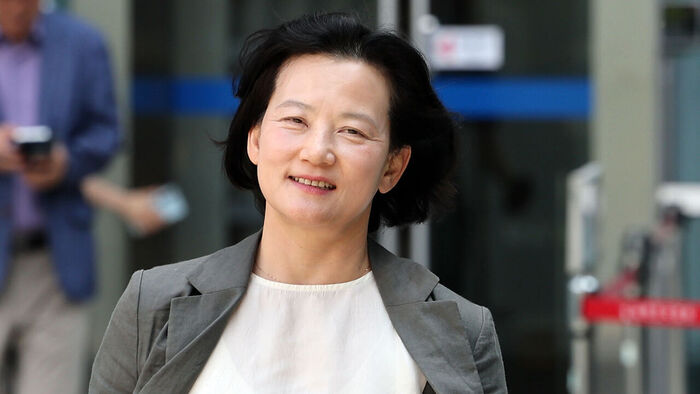
▲ Chief Prosecutor Jung Yu-mi (Prosecutor at Daejeon High Prosecutors' Office), who was effectively demoted to a lower-ranking position in a Ministry of Justice reshuffle, leaves the Seoul Administrative Court in Seocho-gu, Seoul, after the first-trial ruling on her lawsuit to cancel the personnel order on June 11.
The Ministry of Justice has filed an appeal against a court ruling that ordered the cancellation of a personnel order deemed a demotion for Chief Prosecutor Jung Yu-mi (Prosecutor at the Daejeon High Prosecutors' Office), arguing that the decision "excessively restricts the authority of personnel management."
In a press notice on June 16, the Ministry of Justice stated, "We have submitted an appeal against the Seoul Administrative Court's ruling, which ordered the cancellation of the personnel order regarding former Legal Research and Training Institute researcher Jung Yu-mi."
In December of last year, while serving as a researcher at the Legal Research and Training Institute, Chief Prosecutor Jung was transferred to the Daejeon High Prosecutors' Office during a high-level prosecution reshuffle.
This effectively amounted to a demotion from a chief prosecutor-level position to a high-prosecutors' office prosecutor position.
Inside and outside the legal community, the move was viewed as a disciplinary measure against Chief Prosecutor Jung, who had publicly voiced critical opinions on issues such as the decision not to appeal the Daejang-dong case and matters concerning prosecution reform.
The day after the personnel announcement, Chief Prosecutor Jung filed a lawsuit against the Minister of Justice to cancel the personnel order, along with an application for an injunction to suspend its execution.
While the court rejected the injunction request, it ruled on June 11 in the first trial that the Ministry of Justice had "deviated from and abused its discretionary power in personnel management" and ordered the personnel order to be canceled.
The court noted that while the transfer of Chief Prosecutor Jung to a high-prosecutors' office position did not constitute a "demotion" under the State Public Officials Act, it found the personnel action inappropriate in terms of its motive, purpose, and procedure.
The court pointed out that the transfer was highly unusual, occurring only months after she was moved from Chief Prosecutor of the Changwon District Prosecutors' Office to a researcher at the Legal Research and Training Institute, and that, based on customary practices, it appeared the Ministry of Justice intended to induce Chief Prosecutor Jung's voluntary resignation.
Regarding the procedure, the court cited the lack of prior notice and the absence of an opportunity to be heard, stating, "If disciplinary grounds were recognized for the plaintiff, it would have been appropriate to follow disciplinary procedures; however, the ministry did not follow proper procedures nor provide an opportunity for explanation."
In response, the Ministry of Justice argued, "This personnel action is a permitted change of position under Article 6 of the Public Prosecutors' Office Act and is not a disciplinary measure." The ministry added, "Nevertheless, the first-trial court appears to have made its judgment on the premise that this action was a punitive measure intended to induce the plaintiff's voluntary resignation."
The ministry further stated, "The first-trial court's judgment that an opportunity for explanation must be provided to the subject of the personnel order before issuing such an order is an incomprehensible decision that excessively restricts the personnel authority of the appointing official," adding, "We have determined that it is necessary to correct the first-trial court's ruling through an appeal."
(Photo: Yonhap News)
※ Please note: This article was translated by AI and may contain errors.