[Anchor]
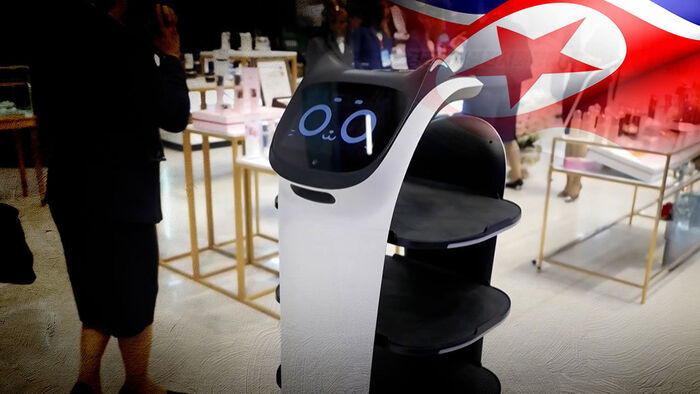
Recent photos of "Pyongyang today," shared on social media by foreign tourists who visited North Korea, are drawing attention. Changes in consumer culture are evident, with serving robots moving through restaurants and payments being made via smartphone QR codes.
Reporter Kim Ayeong has the story.
[Reporter]
As a serving robot passes between empty tables, a North Korean man wearing a badge that appears to feature Kim Jong-il looks on with curiosity.
This is a video posted on social media in April by a Chinese national, who identified the location as the Rakrang Patriotic Kumgang Store in Pyongyang.
North Korea unveiled serving robots at a light industry exhibition last October, and it is presumed that they have been deployed here on a trial basis.
Inside this store, there are also shops that mimic overseas brands.
A coffee shop named "Mirae Reserve," which seems to imitate the logo of the high-end Starbucks Reserve, is visible, and a North Korean version of IKEA selling interior goods has also been spotted.
A smartphone-based consumer culture is also visible.
Smartphones are equipped with ride-hailing apps, and signs are posted in various places indicating that QR code payments are available.
Last month, Singaporean Foreign Minister Vivian Balakrishnan, who visited Pyongyang, commented that Pyongyang has achieved significant development compared to his visit eight years ago.
[Jung Eun-lee / Head of North Korean Studies Division, Korea Institute for National Unification: The North Korean economy was extremely difficult during the COVID-19 period. (However, now) overall urban life seems to have improved. Looking at the results, it seems that a lot has changed since the North Korea-Russia (rapprochement).]
Assessments suggest that the economic situation has improved due to compensation from arms exports and troop deployments to Russia, an increasing trend in trade with China, and the absence of large-scale natural disasters for several years.
According to the Bank of Korea's estimate last year, North Korea's real GDP in 2024 grew by 3.7% compared to the previous year, marking the largest growth in eight years.
However, as the gap between Pyongyang and the provinces remains significant, experts point out that it is difficult to view these changes as an improvement in the living standards of all North Korean residents.
(Video Editing: Park Sun-soo, Source: X, Xiaohongshu)
※ Please note: This article was translated by AI and may contain errors.
Surprising Photos on Social Media: A Transformed Pyongyang
By Kim Ayeong | Jun 16, 2026