[Anchor]
It has been 100 days since the implementation of the so-called "Yellow Envelope Act," which allows subcontracted union workers to bargain directly with the prime contractor. Recently, the definition of an employer has been interpreted more broadly, with rulings stating that even subcontracted workers in cafeteria and laundry services are eligible for direct negotiations with the prime contractor.
Reporter Jeon Hyeong-u has the story.
[Reporter]
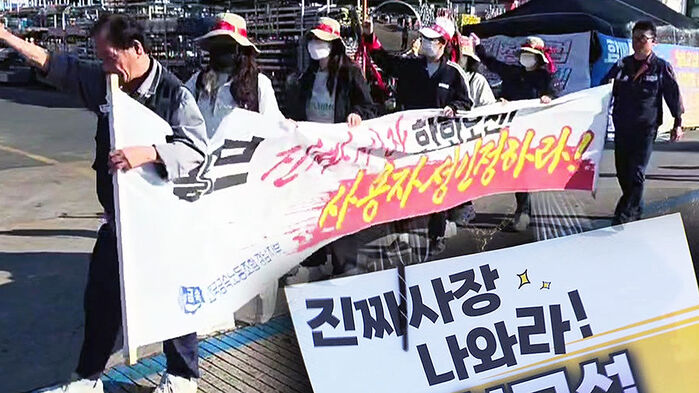
Subcontracted workers at Hanwha Ocean who provide support services such as cafeteria, laundry, and shuttle bus operations have consistently demanded direct negotiations with the prime contractor.
[Hanwha Ocean Subcontracted Union: All workers at Hanwha Ocean must be able to engage in direct negotiations with the prime contractor.]
The National Labor Relations Commission (NLRC) has ruled that Hanwha Ocean must engage in negotiations with these workers.
The commission determined that Hanwha Ocean, as the prime contractor, qualifies as an employer under the Trade Union Act because it exercises substantial and specific control over the safety and working conditions of the subcontracted workers.
The NLRC explained its reasoning, stating, "Improvements to aging facilities in areas such as kitchens, laundry rooms, and shuttle buses cannot be implemented by the subcontractor alone without the cooperation and approval of Hanwha Ocean."
The Ulsan Regional Labor Relations Commission also recognized that Hyundai Motor Company must comply with negotiation demands from 10 subcontracted unions responsible for cafeteria and security services.
As rulings that broadly recognize the employer status of prime contractors continue to emerge, the business community is pushing back.
[Jang Jeong-woo, Head of Labor-Management Cooperation at the Korea Enterprises Federation: We are concerned that confusion will increase as the scope of bargaining partners is expanded to include even indirect support and cooperation relationships, rather than just direct production-related prime-subcontractor relationships.]
As of today, June 17, marking 100 days since the implementation of the Yellow Envelope Act, 1,151 subcontracted unions have requested negotiations with 434 prime contractors as of the 12th.
Among them, 90 prime contractors have announced their intent to negotiate, but only 8 have actually begun the process, accounting for just 1.8% of the total.
[Yang Kyung-soo, President of the Korean Confederation of Trade Unions (on the 10th): When we opened the lid, we found that there are no employers coming to the table. Many companies that initially said they would participate in negotiations are now filing for retrials with the NLRC.]
In the early stages of the law's implementation, there is a strong tendency to seek legal judgments.
There are growing concerns that the process—going through regional labor commissions, the national commission, and even administrative litigation—may take too much time and cost too much to reach actual negotiations.
(Video reporting: Bae Moon-san | Video editing: Kim Ho-jin | Screen source: Korean Metal Workers' Union Shipbuilding Subcontracting Branch | Data provided by: Office of Representative Kim So-hee)
※ Please note: This article was translated by AI and may contain errors.
"Direct Bargaining for Cafeteria and Laundry Workers": Will It Delay Negotiations?
By Jeon Hyeong-u | Jun 17, 2026