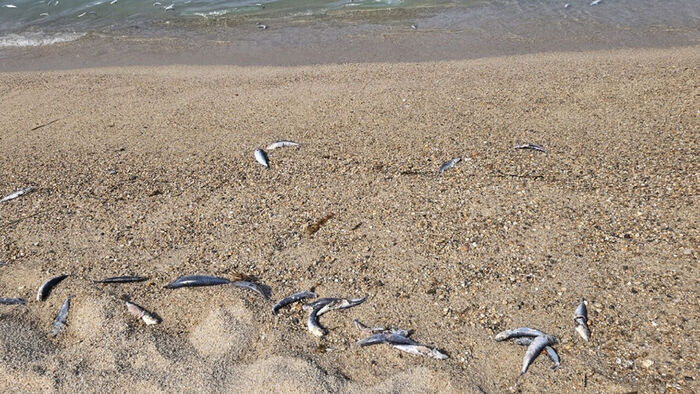
▲ Dead mackerel washed up on Yeongok Beach in Gangneung
Following a recent spike in bluefin tuna catches along the east coast of Gangwon Province, a mass die-off of fish, including mackerel, has left them washing up on shore, drawing attention to the potential causes behind the phenomenon.
On the afternoon of June 16, hundreds of dead fish, including mackerel and herring, were discovered along the coast of Yeongok Beach in Gangneung.
Some of the fish were found floating in the sea before being washed onto the sandy beach by the waves. The resulting stench caused discomfort for local residents and tourists in the area.
A witness who reported the incident said, "There were various species mixed together, including what looked like juvenile mackerel, and they kept washing up from the sea," adding, "The smell was very strong."
Similar sightings of dead mackerel have also been reported recently at nearby locations, such as Gyeongpo Beach.
City officials believe it is unlikely that the deaths were caused by marine pollution.
A city official explained, "So far, no unusual findings, such as the influx of pollutants, have been identified," adding, "It is possible that this is related to the recent increase in bluefin tuna catches."
The official further noted, "Small fish can sometimes get trapped and die from the shock while set-net fishing vessels are hauling in bluefin tuna," and suggested, "It is possible that these carcasses were carried to the shore by currents and waves."
In fact, bluefin tuna have recently been approaching the coast in large numbers, leading to a significant increase in catches by set-net fishing vessels along the east coast.
Bluefin tuna are major predatory fish that feed on smaller species, including anchovies, juvenile mackerel, and horse mackerel.
Previously, on June 10, a school of anchovies was found washed up and dead on Gyeongpo Beach.
At that time, experts speculated that the phenomenon occurred as the anchovies were driven toward the shore while being chased by higher-level predators such as mackerel or herring.
Some analysts suggest that these fish die-offs may be linked to recent changes in the marine environment along the east coast.
They argue that a combination of factors, including an increase in warm-water species like bluefin tuna, shifts in the movement of prey, and changes in water temperature, may be having a complex impact.
The city is currently collecting the dead fish washed up on the shore and investigating the exact cause of the incident.
(Photo: Provided by reader, Yonhap News)
※ Please note: This article was translated by AI and may contain errors.