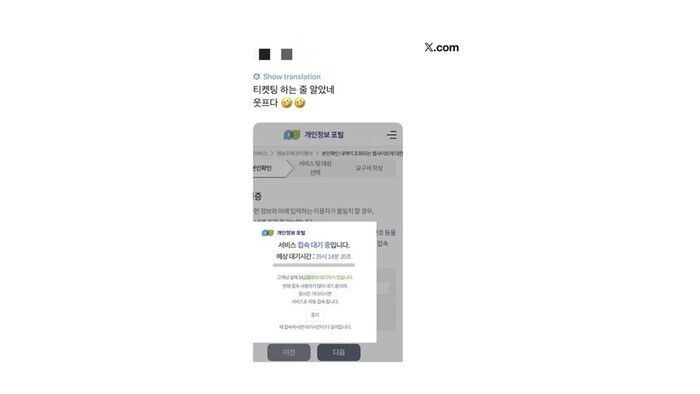
▲ The waiting screen for accessing the Personal Information Portal
'39 hours, 14 minutes, and 20 seconds.'
This was the estimated waiting time shown in a pop-up window when accessing a service on the Personal Information Portal that helps users withdraw from unnecessary websites at around 10 p.m. on June 14.
As a series of personal information leak incidents have occurred recently, users are flocking to government services that help check mobile phone identity verification history and withdraw from unnecessary websites.
On Wednesday (June 17), according to the Personal Information Protection Commission (PIPC), the number of applications for the "Website Membership Withdrawal Support Service" on the Personal Information Portal reached 80,321 as of 4:40 p.m. on June 15.
This is a threefold surge compared to the 26,851 applications received on June 11 alone.
Although the service is designed to help users withdraw from websites where identity theft is suspected or that are no longer in use, it has frequently experienced near-paralysis recently due to a sudden influx of users.
On the afternoon of June 14, the number of simultaneous waiting users exceeded 14,000.
The cumulative number of uses over the five days since June 11 reached 247,381.
Even when accessing the site at around 10 a.m. on June 16, there were about 5,000 people waiting, with an estimated wait time of approximately 14 hours.
An official from the PIPC explained the recent increase in users, saying, "We see this as a result of growing awareness of the importance of personal information, as well as increased interest in preventing personal data leaks and exercising the rights of data subjects."
Behind the surge in service applications are repeated personal information leak incidents.
Citizens' vigilance has grown as personal information leaks have spread across all sectors, affecting not only private companies like Coupang and TVING but also public services such as Government24 and Seoul's public bicycle sharing service "Ttareungyi."
The number of personal information leak reports received last year was 447, an increase of about 45.6% compared to 307 in 2024.
In particular, personal information leak incidents caused by hacking surged by more than 100 cases, rising from 171 in the previous year to 276.
Public anxiety is also on the rise.
According to the Ministry of Data and Statistics' Korean Statistical Information Service (KOSIS) and the 2024 Social Survey, 57.6% of respondents answered that they felt "not safe" regarding personal information leaks.
This means nearly six out of ten citizens feel anxious about personal data leaks.
Instead of relying solely on the Personal Information Portal, there is also a growing movement to share ways to prevent personal information leaks through social media.
Various methods are being introduced, such as "checking for leaked passwords in the iPhone Passwords app," "disconnecting linked accounts after checking Naver and Kakao connections," and "using services to find my leaked information on the dark web."
In online communities, users have shown bittersweet reactions, asking, "Do we now have to delete our personal information like we're booking concert tickets?" along with weary comments such as, "There are too many things we have to take care of ourselves, and even then, it's hard to fully trust them."
Some also question how effective these individual efforts will be.
A 24-year-old graduate student surnamed Lee said, "With trust in personal data security broken due to multiple leak incidents, I doubt whether these methods will actually prevent anything. I sometimes feel helpless, wondering what the point is of withdrawing so late."
While experts view the shift in awareness regarding personal information protection positively, they point out that companies and the government need to strengthen their responsibilities.
Kim Young-gab, a professor of information security at Sejong University, evaluated it as "a positive phenomenon, as it is an exercise of one's rights over their own information."
However, he pointed out, "It also means that personal information is being vulnerably leaked to that extent," adding, "It seems that companies' awareness of security is lower than that of the public."
Professor Kim said, "To ensure that domestic personal information leak incidents do not just end up as temporary hot topics, efforts to strengthen corporate and government-level responsibility through legislative amendments are desperately needed."
(Photo: Captured from X, Yonhap News)
※ Please note: This article was translated by AI and may contain errors.