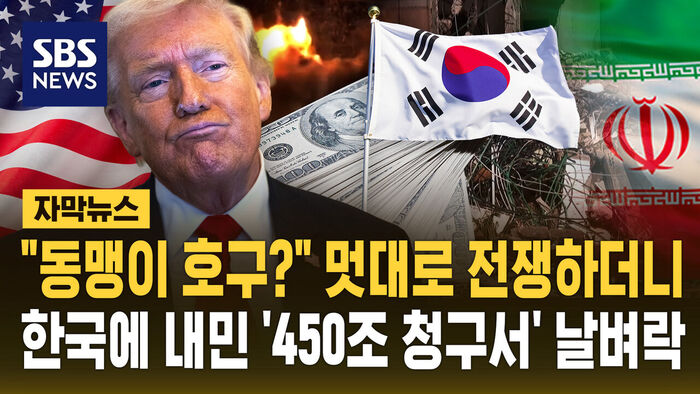
As the United States and Iran sign a memorandum of understanding (MOU) to end the war, a fierce controversy is erupting over the so-called "Iran Reconstruction Fund," estimated at $300 billion (approximately 450 trillion won).
This is because the burden of this massive fund appears to be falling on allies, including South Korea and Japan, as well as private companies.
While the Trump administration has framed it as a "private investment fund" to avoid the appearance of being a defeated nation, it is highly likely to be perceived as war reparations by Iran, which has been demanding compensation for war damages.
This is why there is growing criticism that the U.S. started a war without consulting its allies, only to pressure them to foot the bill.
Opposition within the United States is also growing uncontrollably.
President Trump, who previously fiercely criticized the Obama administration for "handing over bundles of cash to Iran," is now facing backlash for authorizing massive financial support without any concrete achievements in denuclearization.
Officially, the Trump administration maintains that it cannot immediately unfreeze Iranian assets in exchange for the signing of the MOU. However, Iran is countering that it will only enter follow-up negotiations if some of its frozen assets are released.
Consequently, even before the main negotiations have begun, it is reported that the U.S. is already preparing "carrots," such as granting exemptions to sanctions on Iranian oil sales.
If true, this contradicts the Trump administration's own stance that sanctions relief can only be pursued once Iran implements specific measures regarding nuclear disarmament.
CNN pointed out that while the frozen Iranian assets released during the Obama administration in 2015 amounted to about $50 billion, the current Trump administration is discussing $300 billion—six times that amount.
Even among hardliners in the Republican Party, voices are emerging that the funding sources of a state sponsor of terrorism must not be unlocked under any circumstances.
Marc Thiessen, known as an advisor to President Trump, harshly criticized the move, stating, "Giving $300 billion to Iran under any circumstances is a disaster," and comparing it to "offering a Marshall Plan to rebuild Nazi Germany."
Behind the Trump administration's excuse that "not a single penny of U.S. money will be used," international criticism of what is being called a humiliating "giveaway" negotiation is expected to intensify.
Reported by Lee Hyun-young | Video by Jang Yu-jin | Graphics by Lee Jung-ju | Produced by SBS Digital News
※ Please note: This article was translated by AI and may contain errors.
BREAKING: "Are Allies Fools?" U.S. Faces Backlash Over $300 Billion 'Iran Reconstruction Bill'
Jun 17, 2026