
▲ Korea Chamber of Commerce and Industry (KCCI)
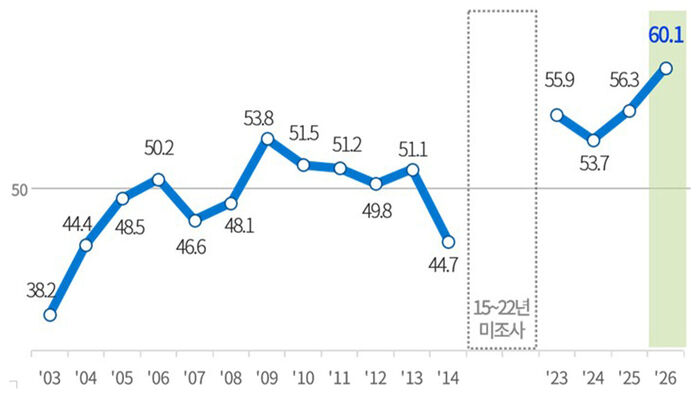
Public favorability toward South Korean businesses has reached its highest level since the survey began in 2003.
The rise in favorability is attributed to improved evaluations of companies' economic contributions and their social roles.
The Korea Chamber of Commerce and Industry (KCCI) announced on Wednesday (June 17) that the "2026 Corporate Favorability Index," based on a recent survey of 1,000 men and women aged 18 and older nationwide, stood at 60.1 points, an increase of 3.9 points from the previous year.
The Corporate Favorability Index quantifies the public's positive perception of businesses. It is calculated by aggregating seven key factors—productivity and technological development, contribution to economic growth, international competitiveness, corporate culture, contribution to local communities, eco-friendly management, and ethical management—along with overall favorability.
A score closer to 100 indicates higher favorability, while a score closer to 0 indicates lower favorability.
This year, both the overall favorability and all seven key factors increased compared to the previous year, marking the highest levels since the survey began in 2003.
International competitiveness saw the largest gain, rising 6.8 points from the previous year, followed by eco-friendly management (4.1 points), productivity and technological development (3.6 points), and ethical management (3.1 points).
In terms of individual metrics, productivity and technological development scored the highest among the seven factors at 67.1 points. Despite improvements from the previous year, ethical management was the only category to fall below the favorability threshold of 50 points, at 47.1 points.
The most cited reason for having a favorable view of businesses was "contribution to the national economy" (45.8%), followed by "job creation" (20.3%) and "satisfaction with products and services" (17.3%).
The most cited reasons for unfavorable views were "insufficient compliance and ethical management" (22.9%), followed by "inadequate consumer protection" (18.6%) and "lack of effort to improve corporate culture" (17.1%).
Furthermore, 86.3% of respondents stated that they "consider a company's image and favorability along with product quality and price," indicating that corporate image influences consumer decisions.
Shin Hyun-sang, a professor at Hanyang University Business School, said, "As more active consumers link their likes and dislikes of companies to their purchasing behavior, companies also need to deeply contemplate their social responsibilities and roles and seek strategies that align with the trends of the times."
In this survey, 85.6% of respondents answered that "it is necessary for companies to step up to solve various social problems," confirming that expectations for corporate participation in solving social issues have been steadily growing, following 58.6% in 2024 and 74.0% in 2025.
Cho Young-jun, head of the KCCI's Institute for Sustainable Management, stated, "The results of this survey show that the social role of businesses has now become a demand of the era rather than a choice," adding, "The KCCI will cooperate with various entities, including the government and local communities, to support more companies in participating in solving social problems."
(Photo courtesy of Korea Chamber of Commerce and Industry, Yonhap News)
※ Please note: This article was translated by AI and may contain errors.