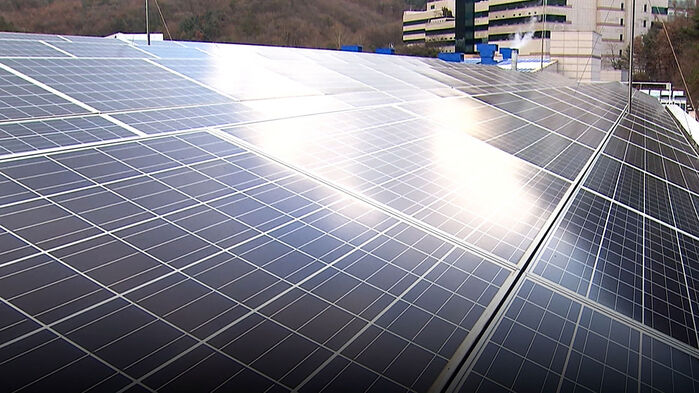
▲ Solar energy panels
Reports indicate that China is expanding its influence over the United States by tightening export controls on key supply chains, extending beyond rare earth minerals to include solar manufacturing equipment.
According to a report by The Washington Post (WP) on June 16 (local time), China has been gradually increasing the number of items subject to control even after securing a "trade truce" last year by countering the Trump administration's tariff policies with export restrictions on rare earths and critical minerals.
The analysis suggests that China's influence is growing across the entire industrial supply chain, including silicon wafers, permanent magnets, light-emitting diodes (LEDs), and battery materials, not just rare earths.
The research firm Rhodium Group assessed that "these intermediate manufacturing sectors are creating additional bottlenecks (in the supply chain), and China is targeting them."
Liza Tobin, a China expert who served on the National Security Council (NSC) during the first Trump administration, stated, "China's intent is to weaponize other supply chains beyond rare earths."
Solar manufacturing equipment is cited as a prime market where China is strengthening its control.
According to some estimates, China holds more than an 80 percent share of the global solar manufacturing market.
Data from the China Photovoltaic Industry Association shows that in 2024, China produced 92 percent of the world's solar cells and 97 percent of its wafers.
While the U.S. is pushing to expand domestic solar production capacity due to rising power demand from the spread of artificial intelligence (AI), it remains heavily dependent on Chinese firms for production equipment, leaving significant room for China to exert influence.
In fact, it was reported that Tesla and SpaceX, led by CEO Elon Musk, were in negotiations earlier this year to purchase production equipment from the Chinese solar equipment manufacturer Suzhou Maxwell, but the talks were halted due to intervention by Chinese authorities.
Two sources in the Chinese solar industry told the WP that Chinese authorities instructed Suzhou Maxwell in March to stop negotiations with Musk's companies and refrain from selling equipment for the time being.
Although an official export ban was not issued through a formal document, it is known that there is significant concern within the industry that defying the authorities' intentions could lead to future disadvantages.
Cameron Johnson, a Shanghai-based supply chain consultant, said, "China is sending a warning message, showing off that 'we have what you need.'"
Some point out that China's supply chain control could backfire in the long term.
This is because the U.S. and its allies are moving to build alternative supply chains to reduce their reliance on China.
The fact that the Korean solar company Hanwha Qcells stated last year that its latest supply chain is "sourced from regions outside of China" was cited as one example.
The WP reported that Chinese companies are also expressing concerns that their future opportunities to enter the U.S. market could diminish due to rising U.S. tariffs and stricter trade regulations.
※ Please note: This article was translated by AI and may contain errors.