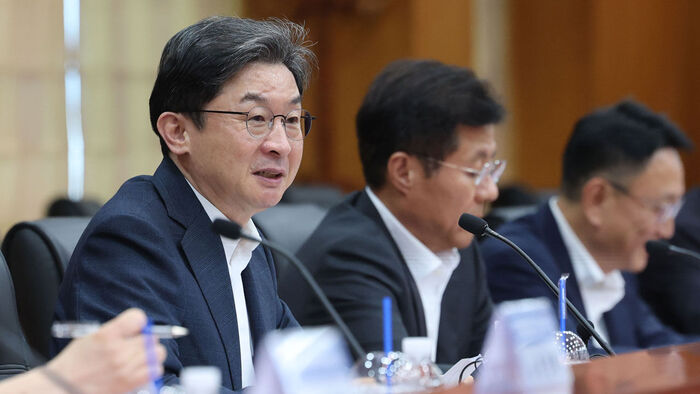
▲ Financial Services Commission Chairman Lee Eog-weon speaks at a meeting with managers of the public-participatory National Growth Fund held at the Korea Financial Investment Association in Yeouido, Seoul, on the 12th.
Financial Services Commission (FSC) Chairman Lee Eog-weon has begun gathering opinions from outside experts on inclusive finance as the first step toward redefining the public role of the financial sector.
This marks the first official event for the "Inclusive Finance Strategy Promotion" task force, which was launched by the FSC to discuss the issue following remarks on the public nature of finance made by Kim Yong-beom, the Presidential Policy Chief, last month.
Experts emphasized the need to revitalize alternative credit evaluation systems, noting that the exclusion of vulnerable borrowers from the financial sector could increase social risks.
Chairman Lee held an "Inclusive Finance Field Discussion" today (June 17) at the Korea Deposit Insurance Corporation in Jung-gu, Seoul, bringing together officials from relevant agencies and various private-sector experts.
Field experts from various organizations, including Rolling Jubilee, Sinaneun Johap (Joyful Union), People Living Together, and the Hwaseong Financial Welfare Counseling Support Center, were invited to attend.
"Inclusive finance is not a one-time measure for public livelihood, but a task for structural reform of the financial system," Chairman Lee said. "We must examine the structure itself to understand why citizens turn away from the threshold of institutional finance and why a single instance of delinquency leads to long-term default."
He further emphasized, "Inclusive finance does not weaken financial principles; rather, it is a path that enables finance to evaluate more accurately, adjust earlier, and resolve problems at a lower social cost."
He stated, "Those pushed outside of institutional finance fall into a vicious cycle of illegal private lending, excessive debt collection, and long-term delinquency, which can lead to increased social costs to resolve these issues."
Lim Soo-kang, an economics Ph.D. who served as vice-chair of the Research Association for Production and Inclusive Finance, diagnosed financial exclusion as a phenomenon resulting from the weakened public role of financial institutions. He pointed out, "If the class of people excluded based solely on quantitative criteria expands, it could lead to a burden on the entire national economy, including deepened inequality, increased costs of social conflict, and loss of labor force."
He added that since large financial institutions alone cannot sufficiently cover the financially excluded, the role of microfinance institutions should be strengthened and cooperation with the Korea Inclusive Finance Agency should be expanded.
Kang Kyung-hoon, a professor at Dongguk University, also emphasized, "Inclusive finance is not merely a welfare benefit, but an infrastructure that absorbs social risks arising from technological innovation, and a productive policy that prevents the erosion of growth momentum caused by employment polarization in the era of artificial intelligence (AI) and automation."
Ko Seok-heon, Executive Vice President of Shinhan Financial Group, suggested, "The biggest constraint on expanding inclusive finance is the high delinquency rate among mid-to-low credit borrowers, which places a heavy burden on financial soundness." He proposed, "We must create a virtuous cycle that turns subprime customers into prime customers by combining the three pillars of quantitative expansion of inclusive finance, easing interest rate burdens, and strengthening alternative credit evaluation."
He also recommended that for financial companies to actively pursue inclusive finance while bearing the burden of soundness, incentives such as reductions in contribution fees and the easing of data regulations to vitalize alternative credit evaluation are necessary.
Following today's discussion, the four subcommittees of the Inclusive Finance Strategy Promotion task force—General, Policy Microfinance, Financial Industry, and Credit Infrastructure—plan to hold their first meetings this month to finalize their respective agendas and operational directions.
(Photo: Yonhap News)
※ Please note: This article was translated by AI and may contain errors.