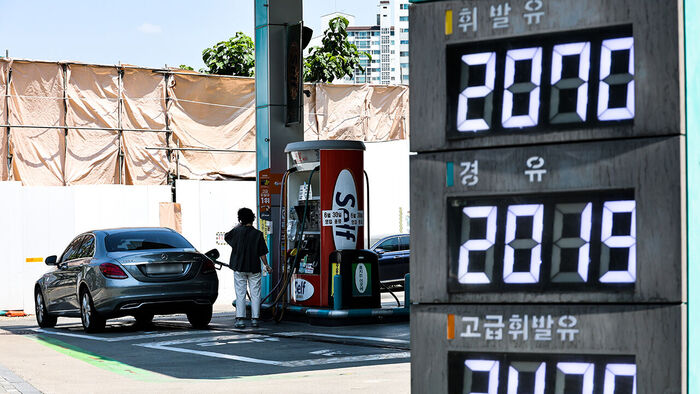
▲ A fuel price information board at a gas station in Seoul
The Bank of Korea (BOK) projected today (June 17) that even if the Middle East conflict ends and oil prices fall, inflation will remain difficult to curb due to improved consumption and rising wages.
In its "Inflation Targeting Operation Assessment" report released today, the BOK stated, "Inflation is expected to maintain a high growth rate for a considerable period."
Regarding future inflation conditions, the BOK diagnosed that while peace negotiations between the U.S. and Iran have progressed, upward pressure on prices remains high.
In particular, the bank noted that while international oil prices are expected to decline as transit through the Strait of Hormuz normalizes, the pace of the decrease will be moderate due to infrastructure restoration and demand for restocking in various countries.
On the demand side, the BOK expects the trend of economic improvement to gradually strengthen.
The analysis suggests that consumption momentum will strengthen as the impact of improved income and asset conditions, driven by strong performance in IT companies, grows.
The BOK noted that while government policies are significantly buffering the inflationary impact of oil price shocks, pressure to raise public utility charges is expected to increase gradually from the second half of the year.
Furthermore, the bank assessed that recent wage hike movements, centered in some IT sectors, could spread across industries, further increasing inflationary pressure.
The logic is that if the exceptional performance bonuses in the semiconductor sector spread to other areas, both supply and demand-side inflationary pressures could increase significantly.
The BOK expects the consumer price index (CPI) to rise by around 3% in the second half of this year, with core inflation reaching the mid-to-high 2% range.
This is because it anticipates that cost-push price pressures, heightened by high oil prices and a strong exchange rate, will gradually spill over into items other than petroleum products.
The BOK also projected that both consumer and core inflation will exceed the target level (2.0%) next year as demand-side pressures gradually expand.
The BOK added that during the past Russia-Ukraine war, oil prices surged, and indirect effects began to appear in non-energy items such as industrial goods about six months later, lasting for approximately one year.
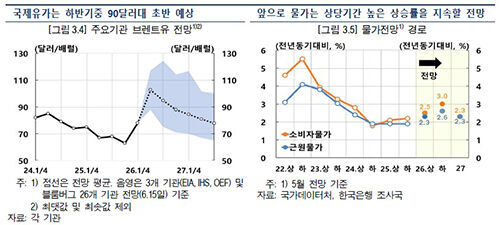
▲ Inflation forecast path, etc.
(Photo courtesy of BOK, Yonhap News)
※ Please note: This article was translated by AI and may contain errors.