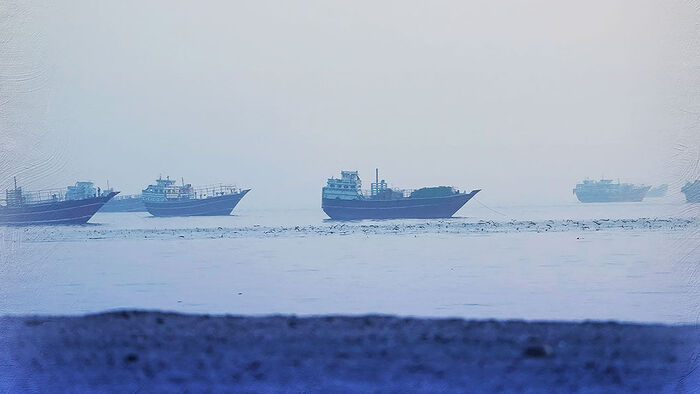
▲ Strait of Hormuz
As the signing ceremony for a peace agreement between the United States and Iran approaches, attention is focusing on the location and scale of Iran's frozen assets held overseas.
According to The Wall Street Journal (WSJ) on June 16 (local time), Iran plans to make the release of its frozen overseas assets a key demand to the U.S. as it enters 60 days of full-scale negotiations to completely end the war following the signing ceremony scheduled for June 19.
The newspaper reported that while some of these frozen assets have been tied up for decades since the 1979 Islamic Revolution, the majority consist of relatively recent payments for crude oil exports.
Previously, during his first term in 2018, U.S. President Donald Trump unilaterally withdrew from the Iran nuclear deal (Joint Comprehensive Plan of Action, or JCPOA), which had been reached during the Barack Obama administration, and reinstated sanctions on Iran.
As a result, countries including China, India, South Korea, and Japan were unable to pay for crude oil imports from Iran, leaving massive amounts of funds frozen in overseas banks.
Estimates regarding the exact scale of Iran's frozen assets overseas vary.
While Iranian authorities claim the amount is at least $100 billion (approximately 151 trillion won), some analyses suggest the figure may be significantly lower.
According to the WSJ, China, which was the largest importer of Iranian crude oil, holds the largest portion of these frozen funds.
Experts estimate that the frozen Iranian assets in China range from $20 billion to $50 billion (approximately 30 trillion to 75 trillion won).
It is reported that significant amounts of Iranian assets were also frozen in Iraq ($15 billion, 22.5 trillion won), South Korea and India ($7 billion each, 10.5 trillion won), Qatar ($6 billion, 9 trillion won), Japan ($3 billion, 4.5 trillion won), and the U.S. and Luxembourg ($2 billion each, 3 trillion won).
However, most of the approximately $7 billion in Iranian assets that were frozen in South Korea have already been transferred to Qatar.
This followed a decision by the former U.S. administration under Joe Biden in September 2023, which allowed the $6 billion (estimated) in Iranian funds held in South Korean banks to be transferred to Qatar in exchange for the release of five Americans detained in Iran, enabling Tehran to use the funds for humanitarian purposes such as purchasing medicine.
Specifically, these funds were transferred to accounts held by the Central Bank of Iran at Qatar National Bank (QNB). While a portion was used for humanitarian purchases for Iran, the funds were frozen again one month later following the outbreak of the war in the Gaza Strip.
The reason the U.S. was able to block countries from paying for Iranian crude oil is that most international oil transactions are settled in U.S. dollars.
However, the WSJ pointed out that even after the current war broke out, China has been secretly importing Iranian crude oil through unconventional means.
It is reported that since official financial settlements were blocked, Iran has been indirectly utilizing some of its frozen funds in China through barter trade, exchanging them for Chinese machinery and automotive parts.
In the current negotiations, Iran's top priority is the phased release of $24 billion (approximately 36 trillion won) of its frozen assets.
Esfandyar Batmanghelidj, CEO of the London-based Bourse & Bazaar Foundation, explained that if a portion of the frozen funds is released, the Iranian leadership could boost the value of its national currency and lower inflation.
※ Please note: This article was translated by AI and may contain errors.