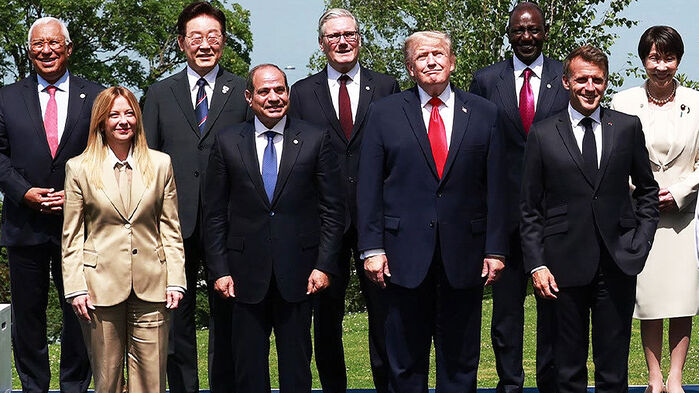
▲ G7 leaders
Leaders of the Group of Seven (G7) have agreed to jointly respond to reduce their dependence on critical mineral supply chains concentrated in China.
In a joint declaration released on June 17 (local time), the G7 leaders defined critical minerals such as rare earths, lithium, and nickel as strategically important resources for digital and energy transitions as well as national security, and announced plans to promote supply chain diversification and strengthen resilience.
The leaders expressed deep concern over export controls, economic coercion, and retaliatory measures regarding critical minerals and related items, emphasizing that they will jointly respond to attempts by specific countries to weaponize resources.
This is interpreted as targeting China, which has virtually attempted to "weaponize the supply chain" through restrictions on rare earth exports.
The G7 set a goal to significantly reduce dependence on any single source outside of the G7 and partner countries in the fields of rare earths and permanent magnets to less than 60% by 2030, and to reach the 50% level as early as possible.
To this end, they decided to promote joint investment and expand industrial capacity across the entire process, from mineral mining to processing and recycling.
For other critical minerals, they instructed relevant ministers to set specific targets by the end of this year to reduce dependence.
The leaders highlighted achievements, noting that a total of 195 critical mineral projects have been announced in G7 and partner countries so far this year, with investment reaching 64 billion euros.
The leaders agreed to continue mobilizing public and private capital to accelerate the establishment of critical mineral supply chains and expand cooperation with developing countries.
The G7 also agreed to establish an international transparency framework to track the origin and distribution channels of critical minerals, starting with lithium and nickel, and to jointly address issues of forced labor and illegal mining.
To prepare for supply disruptions, they will expand strategic stockpiles and establish a joint warning system to detect market distortions or supply-demand crises early.
The G7 leaders also established a policy to build a circular economy and increase supply chain stability by significantly expanding critical mineral recycling capabilities.
They will strive to achieve recycling targets for key minerals by the end of this year and build the capacity to meet a significant portion of G7 consumption with recycled resources by 2030.
To pursue these goals, the leaders agreed to launch the "Critical Minerals Resilience and Production Alliance" and establish a supply chain information-sharing and joint response system with the support of the International Energy Agency (IEA) and the Organisation for Economic Co-operation and Development (OECD).
On this day, the G7 also agreed to achieve balanced and sustainable global growth by reducing global imbalances.
The leaders pointed to non-market policies and practices, and the resulting market distortions and overcapacity, as the main causes of global trade imbalances. They urged large current account surplus countries to grow private demand, while deficit countries should strengthen fiscal soundness to resolve global imbalances.
This, too, appears to target China.
The U.S. and the EU have previously criticized China's massive industrial subsidies and overcapacity for worsening global trade imbalances.
Along with this, the G7 issued a joint declaration calling for the creation of a safer digital environment for children and youth.
The leaders emphasized that digital service providers should apply child and youth protection features by default and strengthen age verification systems.
In particular, with the spread of conversational artificial intelligence (AI) services, they urged the establishment of safeguards to protect the safety and mental health of children and youth.
The G7 also proposed that digital service providers implement effective detection and removal measures to prevent criminal acts, such as child sexual exploitation material including deepfakes and the distribution of non-consensual private images.
In addition, they proposed that appropriate safeguards be established and cooperation with law enforcement agencies be maintained to prevent exposure to online violent extremism and terrorism, as well as attempts by drug trafficking organizations to recruit minors.
※ Please note: This article was translated by AI and may contain errors.