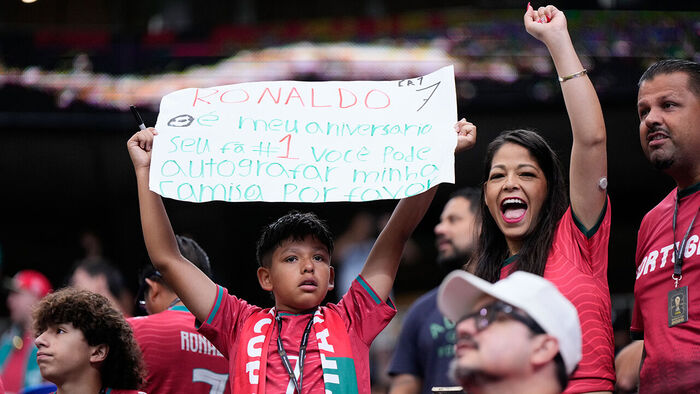
▲ Portuguese football fans cheering at the stadium, asking Cristiano Ronaldo to sign their jerseys
The Portuguese national football team, led by "superstar" Cristiano Ronaldo, suffered a blow to their pride after being held to a draw by the Democratic Republic of the Congo (DR Congo).
Portugal (ranked 5th in the FIFA rankings) drew 1-1 with DR Congo (ranked 46th) in their first Group K match of the 2026 FIFA World Cup, held at Houston Stadium in Texas, U.S., on June 18 (KST).
Portugal, considered one of the tournament favorites, struggled against DR Congo, a team widely seen as underdogs on paper, suffering a painful draw that bruised their reputation.
Portugal's captain, Ronaldo, started as the lone striker in a 4-2-3-1 formation, increasing his total number of World Cup appearances to 23.
By stepping onto the pitch for his sixth World Cup, he became only the second player in history to feature in six different tournaments, following Argentina's Lionel Messi, though he failed to record an attacking point.
Pressing hard from the start, Portugal found an early breakthrough.
Pedro Neto delivered a precise cross from the left flank, which Joao Neves met with a header in front of the goal to find the back of the net.
However, despite dominating possession with a 490-119 pass advantage, Portugal struggled to create clear shooting opportunities in a frustrating display.
They were outshot 2-6 in the first half, with their only shot on target being the early goal.
Instead, they repeatedly conceded chances to DR Congo, who looked to equalize on the counter, and were eventually punished late in first-half stoppage time.
In the 50th minute of the first half, DR Congo scored a dramatic equalizer from a corner kick.
Arthur Masuaku delivered a cross, and Yoane Wissa, left virtually unmarked by the Portuguese defense, rose high to power a header into the net.
It was the first-ever World Cup goal scored by the country under the name "Democratic Republic of the Congo."
With the score tied at 1-1, Portugal appeared to have scored a spectacular go-ahead goal 10 minutes into the second half, only for it to be ruled out for offside.
Bruno Fernandes floated a long cross into the penalty box, which Neves controlled with his chest, setting up the ball for Joao Cancelo.
Cancelo connected with a bicycle kick, sending the ball precisely into the top corner of the net.
However, the assistant referee's flag went up immediately, and the goal was disallowed.
In the 23rd minute of the second half, Ronaldo, who had not registered a single shot all match, finally got a scoring opportunity.
Substitute Francisco Conceicao penetrated the penalty box and delivered a cutback pass to his captain in front of the goal.
However, Ronaldo failed to time his shot correctly, and his rushed effort went wide to the right of the goal.
Five minutes later, Ronaldo connected with another cutback pass from Fernandes, but his shot missed the target again, adding to his frustration.
DR Congo maintained their resilient defense until the final whistle, and Portugal struggled to break through their defensive wall.
Portugal stepped up their attack in the second half, dominating possession with nearly three times as many passes (765-253), but they were still outshot 5-8 overall (1-2 in shots on target), failing to salvage their pride.
In stark contrast to his "eternal rival" Messi, who put on a one-man show with a hat-trick to lead Argentina to a 3-0 victory against Algeria in their Group J opener the previous day, Ronaldo had little impact on the game.
Despite playing the full 90 minutes, he was limited to just three shots, none of which were on target.
Meanwhile, DR Congo celebrated their first-ever World Cup goal and a valuable draw against one of the tournament favorites.
After a grueling campaign that went down to the inter-confederation playoffs, DR Congo edged out Jamaica to qualify for the World Cup finals for the first time in 52 years, since the 1974 tournament in West Germany.
In the 1974 tournament, they competed under the name "Zaire."
(Photo: AP, Yonhap News)
※ Please note: This article was translated by AI and may contain errors.