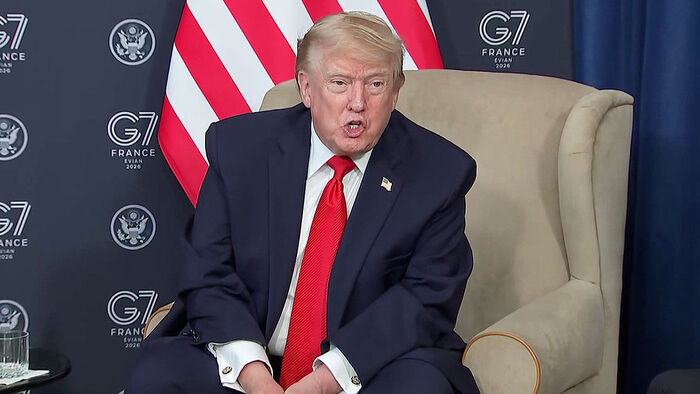
▲ U.S. President Donald Trump
On June 17 (local time), the U.S. Donald Trump administration disclosed the full text of a 14-clause memorandum of understanding (MOU) with Iran to end the war.
During a phone briefing on the same day, a senior Trump administration official read out the clauses of the MOU, which include ending military operations, permanently ending the war, launching a 60-day negotiation for a final agreement on Iran's nuclear program, resuming free navigation in the Strait of Hormuz, banning Iranian nuclear weapons, addressing the disposal of Iran's highly enriched uranium, and easing sanctions against Iran.
While media outlets, including Bloomberg News, had previously obtained and published a draft of the MOU, this is the first time the Trump administration has released the full text of the agreed-upon MOU.
Article 1 of the MOU states, "The United States and Iran declare an immediate and permanent end to military operations on all fronts, including Lebanon, and pledge to refrain from mutual threats or the use of force. The final agreement will confirm the permanent end of the war on all fronts."
Article 2 reads, "The two countries will respect each other's sovereignty and territorial integrity in the future. Both sides also pledge not to interfere in each other's internal affairs."
In Article 3, the two countries "pledge to negotiate and complete a final agreement within a maximum of 60 days, which may be extended by mutual agreement."
Articles 4 and 5 specify measures by both sides regarding the Strait of Hormuz.
The MOU states, "Upon signature, the United States will begin lifting the maritime blockade and other obstructions against Iran, fully lifting the blockade within 30 days and gradually restoring vessel transit to pre-war levels," adding, "The United States also agrees to withdraw its forces from the vicinity of Iran within 30 days after the conclusion of the final agreement."
It also notes, "Iran will do its utmost to guarantee the free two-way transit of commercial vessels through the Strait of Hormuz without fees for only 60 days, and civilian transit will be restored immediately," and "Iran will complete minesweeping and other technical and military measures within 30 days, and will consult with Oman and Gulf states regarding future management and maritime services."
This is expected to spark controversy in the future, as it can be interpreted as limiting toll-free transit through the Strait of Hormuz to 60 days, leaving open the possibility of imposing toll-like fees under the guise of management and maritime services thereafter.
The senior U.S. official said, "We expect Iran to cease any attempts to block transit through the Strait of Hormuz before the signing of the MOU."
Article 6 of the MOU specifies, "The United States will work with regional partners to develop a final, mutually agreed-upon plan for Iran's reconstruction and economic development, valued at a minimum of $300 billion (approximately 465.3 trillion won)."
It adds, "The implementation mechanism for this plan will be finalized within 60 days, and the United States will provide all necessary licenses and waivers for related financial transactions."
Article 7 states, "The United States pledges to lift all sanctions against Iran, including UN Security Council resolutions, IAEA Board of Governors resolutions, and unilateral U.S. primary and secondary sanctions, in accordance with a schedule to be determined in the final agreement," adding, "Both sides recognize the core importance of the sanctions issue and will address it immediately in negotiations."
Article 8 states, "Iran reaffirms that it will not acquire or develop nuclear weapons," and goes on to say that the two countries "agree to resolve the issue of disposing of stockpiled enriched materials through a mutually agreed mechanism in accordance with the schedule mentioned in Article 7, with the minimum method being on-site dilution under the supervision of the IAEA."
In this regard, the senior U.S. official explained during the briefing, "Iran agrees to dispose of its stockpiled enriched uranium through dilution at a minimum," adding, "On-site dilution under IAEA supervision will be the minimum method."
Article 9 stipulates, "Until the final agreement, both sides agree to maintain the status quo, and Iran will keep its nuclear program in its current state," adding, "The United States accordingly agrees not to impose new sanctions or deploy additional forces to the region during this period."
Article 10 states, "Upon signature, the U.S. Department of the Treasury will put into effect waivers allowing Iran to export crude oil, petroleum products, and derivatives," adding, "These waivers will extend to related services, including banking, insurance, and shipping, and will remain in effect until sanctions are lifted."
Article 11 reads, "The procedures for releasing and using frozen or restricted Iranian funds and assets will be mutually agreed upon during the negotiation process, and the United States will ensure full access to them," adding, "The funds may be used for payments to final beneficiaries designated by the Central Bank of Iran, and the United States will issue all necessary licenses for this purpose."
In Article 12, the United States and Iran agreed to "establish an enforcement mechanism to monitor the implementation of the MOU. The same mechanism will also track compliance with the future final agreement."
In Article 13, both sides stated, "Once the ceasefire, naval withdrawal, Strait of Hormuz measures, oil sanctions waivers, and asset releases are underway, the two countries will begin negotiations on the remaining elements of the final agreement," adding, "This sequence is explicitly linked to the continuous implementation of Articles 1, 4, 5, 10, and 11 in particular."
Lastly, Article 14 stipulates, "The final agreement will be endorsed by a United Nations Security Council resolution."
Regarding the signing ceremony for the MOU scheduled to be held in Switzerland on June 19, the senior U.S. official said, "It will be highly significant in gauging how negotiations with Iran will progress."
Although the MOU has already been electronically signed by both sides, the official noted, "Either side can withdraw until a binding agreement is signed."
Regarding the negotiation agenda with Iran after the signing of the end-of-war MOU, he also stated, "After resolving the nuclear issue, we plan to discuss the issue of funding for [Iran's armed] proxy forces."
He added, "If a final agreement is reached and Iran behaves properly, we will allow sanctions relief."
However, the official warned, "If an agreement is not reached, President Trump will not be afraid to use the tools at his disposal," hinting that attacks on Iran could resume if future negotiations fall through.
※ Please note: This article was translated by AI and may contain errors.