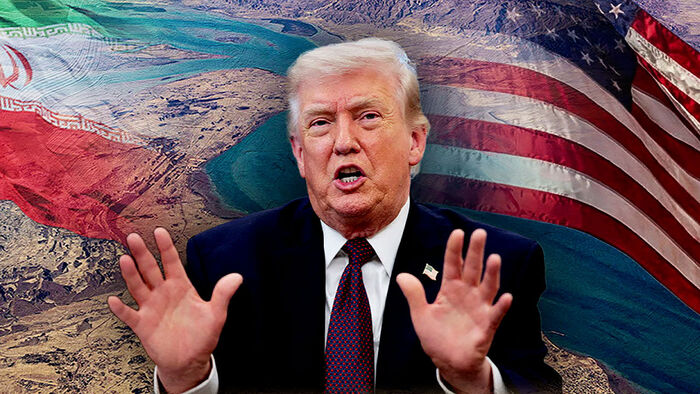
▲ U.S. President Donald Trump
As the U.S. Donald Trump administration on June 17 (local time) released the full text of the memorandum of understanding (MOU) to end the war with Iran, President Trump warned that the U.S. would resume bombing if Iran fails to comply with the agreement.
President Trump, who is visiting France to attend the Group of Seven (G7) summit, held a press conference locally on the same day and said of the MOU to end the war, "We achieved all the goals we wanted to achieve, and more."
President Trump said the core of the agreement is "to ensure that Iran cannot have nuclear weapons, and they cannot develop or purchase nuclear weapons," adding, "If they do not comply with the agreement, we will bomb them again until they do."
President Trump repeatedly criticized former President Barack Obama's 2015 Iran nuclear deal (Joint Comprehensive Plan of Action, or JCPOA), calling the "Obama deal" a "pathway to nuclear weapons."
Referring to the agreement between the U.S. and Iran as the "Trump deal," President Trump praised it, saying, "This is a wall to block the path to nuclear weapons. No one can get through it. We built a wall, and they cannot have nuclear weapons."
He also noted that the stock market has surged and oil prices have plummeted since the agreement, saying, "What I did not want to see was an economic catastrophe."
The remarks are interpreted as suggesting that the economic costs of a prolonged war were among the background reasons for pursuing the agreement to end the war.
President Trump also said that the escalation of military conflict with Iran "could have caused an international depression."
He then mentioned former U.S. President Herbert Hoover during the Great Depression of the 1930s, adding that he did not want to be like Hoover.
President Trump also spoke about the $300 billion (approximately 454 trillion won) reconstruction fund for Iran specified in the MOU, saying, "If Iran behaves properly, if people want to invest in Iran, they will be able to do so," making it clear that Iran's compliance with the agreement is a prerequisite for the reconstruction fund.
Regarding the release of Iran's frozen assets, he said, "It's not our money, it's their money," adding, "We tied it up, and I think at some point we'll probably have to give it back."
The MOU released on this day included a clause stating, "The United States commits to ensuring that the frozen or restricted funds and assets of the Islamic Republic of Iran become fully accessible at the time this MOU is implemented."
President Trump said he practically views the current Iranian leadership as a "regime change," assessing, "I think the new leadership group is much smarter, less radical, and great people."
Regarding the G7 summit being held immediately after the agreement on the MOU to end the war, President Trump said, "It couldn't have happened at a more appropriate time," adding, "I hope this peace agreement will be the beginning of a much larger agreement across the Middle East."
President Trump also expressed gratitude to Chinese President Xi Jinping and Russian President Vladimir Putin for remaining neutral during the war with Iran, saying that thanks to them, the situation was much better.
After traveling from Evian, where the G7 summit was held, to Paris to attend a dinner with French President Emmanuel Macron at the Palace of Versailles, President Trump met with reporters at the airport. When asked, "The MOU contains a clause to refrain from the threat of using force, so isn't saying you will bomb Iran if they do not implement the agreement a threat?" he replied, "I don't care what you call it, but that's what's going to happen."
This maintained the level of warning by reaffirming his existing position that military action could resume if Iran violates the agreement.
President Trump said of Iran's possession of ballistic missiles, "If other countries have them, it's a little unfair that Iran can't have some."
This is interpreted as indicating that while blocking Iran's development of nuclear weapons, he could take a more flexible approach to the ballistic missile issue.
At this point, there could be a difference in interests between the United States and Israel, which started the war together.
President Trump suggested that the 60-day follow-up negotiations to be held after the signing of the MOU could be applied flexibly, saying he does not view the 60 days as a "hard deadline" "as long as they behave properly."
Meanwhile, regarding whether to reimpose oil-related sanctions on Russia that were lifted during the war with Iran, President Trump stated, "I wanted oil prices to stay as low as possible, and now oil prices have gone down significantly," adding, "We could impose them again."
※ Please note: This article was translated by AI and may contain errors.