[Anchor]
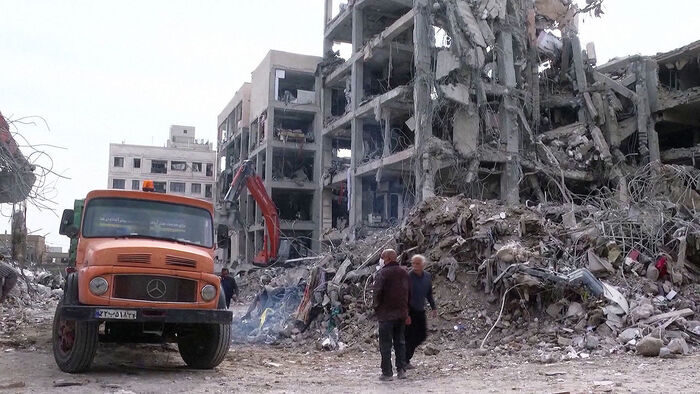
With the midterm elections approaching in November, U.S. President Donald Trump is reassuring voters that not a single cent of American money will be used to raise the $300 billion fund for Iran's reconstruction. However, international backlash is growing over the notion that while the U.S. waged the war, it expects its allies to foot the bill for reconstruction. There are concerns that South Korean companies could also be drawn into this situation.
Reporter Kang Min-woo has the story.
[Reporter]
Article 6 of the Memorandum of Understanding (MOU) on the end of the war, released by the U.S., states that "the United States will work with regional partners to develop a final, mutually agreed-upon Iran reconstruction and economic development plan of at least $300 billion."
The phrase "work with regional partners" has been interpreted as a move by the U.S. to raise the funds—amounting to approximately 465 trillion won—from its allies rather than from its own coffers.
[Vance / U.S. Vice President: We will encourage other nations, not the United States, to invest in Iran. This is only possible if Iran strictly complies with the terms of the agreement.]
Previously, Reuters also cited U.S. government officials as saying that companies in the U.S. and Asia have already agreed to raise over $150 billion in funds, with South Korean companies also being mentioned.
Concerns are mounting that the U.S., which unilaterally started a war without prior information sharing with its allies and placed a massive burden on the global economy, is now passing the costs of war recovery onto the Middle East—which suffered from retaliatory attacks—and private companies in allied nations.
[Cho Han-bum / Senior Research Fellow at the Korea Institute for National Unification: It would be very unfavorable for us if we are forced to invest in projects with low profitability, or if the U.S. takes all the lucrative opportunities.]
Specific details regarding funding and operational methods are expected to be decided through negotiations over the next 60 days. Given the need to enter the Iranian reconstruction market and ensure safe passage through the Strait of Hormuz, it will be difficult for the South Korean government and companies to simply ignore participation in the fund, deepening their dilemma.
(Video Editing: Kim Jun-hee)
※ Please note: This article was translated by AI and may contain errors.
U.S. Starts the War, Allies Pay the Bill? Concerns Over 'Iran Reconstruction' Costs
Jun 18, 2026