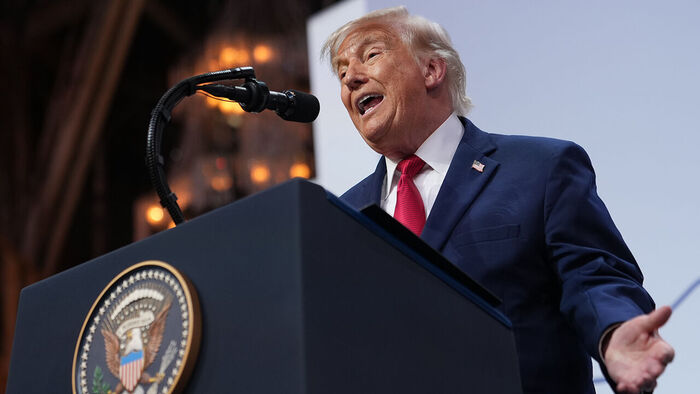
▲ President Trump holds a press conference in France, where the G7 summit is being held, on June 17 (local time).
President Donald Trump, who previously criticized the Iran nuclear deal (JCPOA) signed by the Barack Obama administration as a "giveaway," appears to have prepared a compensation package of a much larger scale.
Article 6 of the memorandum of understanding (MOU) released by the U.S. and Iran on June 17 (local time) states, "The United States commits to working with regional partners to establish a definitive and mutually agreed-upon plan of at least $300 billion for the reconstruction and economic development of the Islamic Republic of Iran."
According to The New York Times (NYT), President Trump met with reporters in Évian, France, where the G7 summit was held that day, and drew a line by stating that the U.S. government would not be contributing funds to the initiative.
However, an administration official explained that the U.S. intends to participate in preparing a comprehensive blueprint for Iran's economic recovery.
While the entity responsible for raising the reconstruction funds remains unclear, experts suggest that if the plan is realized, the economic benefits Iran would receive could far exceed those from the nuclear deal during the Obama administration.
This has led some to point out that the Trump administration's negotiation results are self-contradictory.
This is because President Trump has consistently criticized the Obama administration for providing $1.7 billion to Iran when it signed the 2015 Iran nuclear deal, labeling it a "giveaway."
Experts analyze that if the agreement between the Trump administration and Iran is realized, the economic benefits Iran would gain would be on a much larger scale than the nuclear deal under the Obama administration.
Daniel Shapiro, a senior fellow at the Atlantic Council, a Washington D.C.-based think tank, assessed, "The scale of economic support proposed in this agreement is much broader than in the past," adding, "It appears to be a plan to reintegrate Iran into the global economic system."
The $1.7 billion provided to Iran by the Obama administration was under the pretext of returning funds that had not been settled during arms deals with the Pahlavi dynasty prior to the 1979 Iranian Revolution.
Separately, the Obama administration allowed Iran to access $50 billion in funds that had been frozen in overseas accounts.
The Obama administration explained that the unfreezing of assets was a measure to persuade hardliners within Iran who were opposed to the agreement with the U.S.
However, at the time, Israel and conservatives in the U.S. protested, arguing that the overseas frozen assets released by the Obama administration were used to support pro-Iranian forces, such as the Palestinian militant group Hamas, the Lebanese militant group Hezbollah, and the Houthi rebels in Yemen.
Claims were also raised that Iran used the newly secured funds for the development of ballistic missiles.
The MOU signed by President Trump on this day also includes provisions to unfreeze assets and terminate sanctions against Iran upon a final agreement.
(Photo: AP, Yonhap News)
※ Please note: This article was translated by AI and may contain errors.