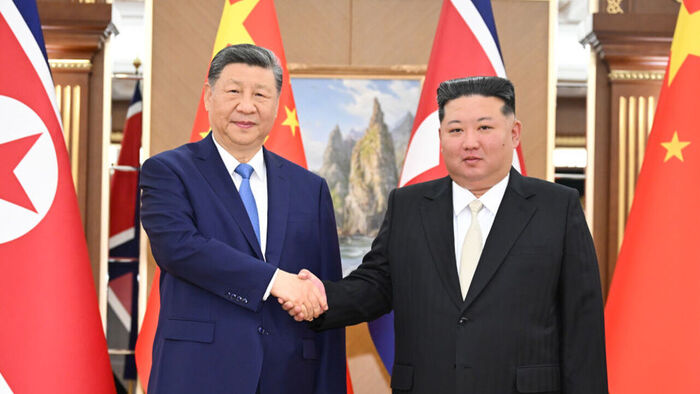
▲ North Korean leader Kim Jong-un and Chinese President Xi Jinping
The South Korean government has reportedly conveyed its concerns to China regarding Beijing's lukewarm attitude toward the issue of North Korea's denuclearization.
According to the Ministry of Foreign Affairs on Thursday (June 18), Nam Jin, Director-General for Northeast and Central Asian Affairs, held a director-level consultation between South Korea and China at the Ministry of Foreign Affairs building in Seoul on Wednesday (June 17) to exchange views on pending bilateral issues and Chinese President Xi Jinping's visit to North Korea on June 8 and 9.
During the meeting, Director-General Nam reportedly asked Liu Jinsong, Director-General of the Department of Asian Affairs at the Chinese Foreign Ministry, to ensure that "the development of North Korea-China relations contributes to peace and stability on the Korean Peninsula, and that China continues to play a constructive role". In particular, regarding the North Korean nuclear issue, Nam is said to have expressed the position that "the spread of rumors about China's acquiescence to North Korea's nuclear program is undesirable and does not help peace and stability on the Korean Peninsula".
Earlier, on June 8, North Korean leader Kim Jong-un and President Xi held a summit in Pyongyang, but the joint statement released after the meeting made no mention of Korean Peninsula issues, including North Korea's denuclearization.
This led to criticism from both inside and outside the Ministry of Foreign Affairs that China has effectively acquiesced to North Korea's self-proclaimed status as a "nuclear-armed state," prompting the South Korean government to convey its concerns to China.
The Chinese side reportedly did not show any distinct reaction to South Korea's remarks, repeating its existing stance that "China's policy on the Korean Peninsula maintains continuity and stability".
While the South Korean government officially maintains the stance that "China is not acquiescing to North Korea's nuclear possession," internally, there appears to be concern over a potential shift in Beijing's attitude toward the North Korean nuclear issue.
During this director-level consultation, South Korea and China confirmed their consensus on promoting high-level exchanges, including a visit to South Korea by Chinese Foreign Minister Wang Yi and vice-ministerial talks for maritime boundary delimitation, but they were unable to finalize the schedules.
The two sides also reviewed friendship-promoting projects agreed upon by the leaders of both countries, such as China's leasing of pandas to South Korea and the preservation of historical sites of the Korean independence movement in China. They also held principled discussions on West Sea structures and boundary delimitation, and exchanged views on North Korea-China economic cooperation. However, South Korea's pursuit of nuclear-powered submarines was reportedly not mentioned.
Director-General Nam said, "Both sides agreed to consolidate the trend of fully restoring South Korea-China relations, which was established through the mutual state visits of the two leaders in November last year and January this year". He added, "In particular, ahead of the Asia-Pacific Economic Cooperation (APEC) summit in Shenzhen this November, we confirmed our commitment to maintaining a positive momentum in high-level exchanges and seamlessly implementing follow-up measures to the summit in fields such as diplomacy, security, economy, culture, and people-to-people exchanges."
China also raised the Taiwan issue, to which the South Korean government reaffirmed its position of respecting the "One China" policy as stated in the 1992 joint communique on the establishment of diplomatic relations between South Korea and China.
The joint communique states, "The Government of the Republic of Korea recognizes the Government of the People's Republic of China as the sole legal government of China, and respects China's position that there is only one China and Taiwan is a part of China."
Director-General Nam said, "This position has remained unchanged across successive administrations."
Previously, after Taiwan protested South Korea's electronic travel authorization system labeling "Taiwan" as "China (Taiwan)" and successfully had the entry removed, China cited the joint communique and stated that it is only natural to refer to "Taiwan" as "Taiwan, China."
(Photo: Captured from Xinhua News Agency, Yonhap News)
※ Please note: This article was translated by AI and may contain errors.