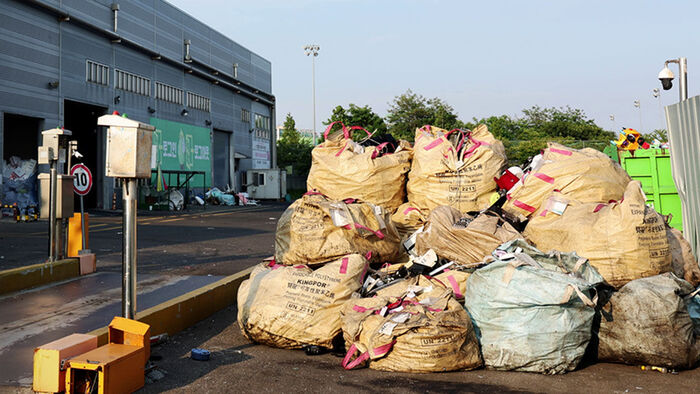
▲ A human leg discovered at a recycling facility in Incheon
The investigation into a human leg found at a recycling facility in Incheon has shifted toward determining how it was discarded, after it was confirmed to belong to a patient currently hospitalized at a nursing home.
According to the Incheon Yeonsu Police Station on June 18, the case, which had remained a mystery for over a week since the discovery, found a breakthrough on June 17 when an official from a local nursing home reported to the police that "the discovered leg may have been disposed of by our hospital."
Police immediately compared the DNA from the leg with that of a patient undergoing treatment at the hospital and received a verbal report from the National Forensic Service on the same day confirming that the two DNA samples matched.
With this development, the focus of the police investigation has shifted from tracking suspects of violent crimes, such as murder, to investigating how the hospital handled medical waste.
The case began on June 10 at 2:28 p.m. when a worker at a resource recovery center in Songdo-dong, Incheon, discovered a portion of a human left leg wrapped in bandages while sorting through recyclables.
In the early stages of the investigation, police kept the possibility of a violent crime open, given that the body part had been severed.
Because the amputation of a human leg is typically accompanied by severe bleeding, there was concern that the owner of the limb might have already died.
Consequently, immediately after the incident, the police formed a 64-member investigation headquarters and mobilized eight scent-tracking dogs from five regional police agencies across the country to search the recycling facility for other body parts.
Noting the small foot size (210 mm), police also investigated long-term or unexcused absences at elementary, middle, and high schools in Incheon, suspecting the owner might be a student.
After receiving preliminary forensic results estimating the person to be an adult between 161 and 165 cm tall, police increased the investigation team to 102 members, secured DNA from families of missing adults in the Gyeongin region, and meticulously examined the routes of 22 vehicles that had entered the recycling facility.
However, the DNA match confirmed on June 18 has brought the case into a completely new phase.
The hospital reportedly stated, "We amputated the patient's leg, which had become necrotic due to lack of blood flow, and disposed of it in a medical waste container according to regulations. However, it is presumed that a cleaning staff member mistook it for plaster cast waste and discarded it incorrectly."
Previously, speculative posts had circulated online suggesting that "medical waste might have been mixed in with general recyclables."
Under the current Wastes Control Act, medical waste, including human tissue, must be stored in dedicated containers and strictly separated from other waste during collection and transport.
The police plan to verify why the patient's leg was not processed as medical waste and whether the hospital's medical staff complied with the Medical Service Act during the amputation procedure.
It has been determined that while the hospital provides care from neurosurgery, general surgery, and traditional Korean medicine staff, it does not have a separate operating room.
A police official stated, "We plan to verify the overall facts, including the specific circumstances under which the leg was discarded and whether the surgery in question was performed legally."
※ Please note: This article was translated by AI and may contain errors.