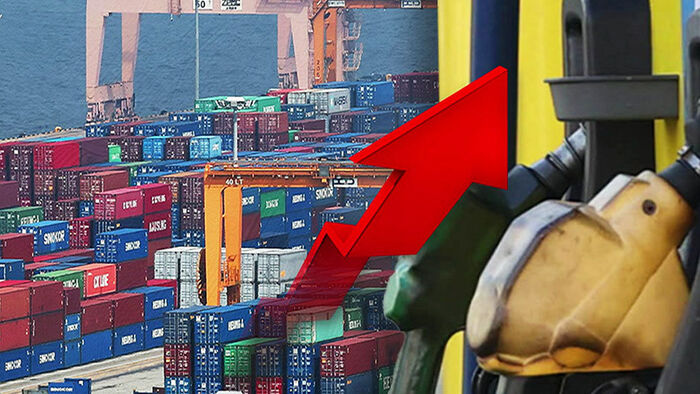
Domestic producer prices continued their upward trend for the ninth consecutive month in May, driven by the ripple effects of rising oil prices and increased service costs following a strong stock market performance.
According to the Bank of Korea on June 19, the producer price index for May stood at 129.82 (base year 2020 = 100), up 0.8% from the previous month (128.75).
This marks a nine-month streak of increases since September of last year.
By category, prices for manufactured goods rose by 0.7%, led by chemical products (1.8%), primary metal products (1.4%), and computer, electronic, and optical products (1.6%).
Within manufactured goods, coal and petroleum product prices, which had recorded their highest growth rates since the Asian financial crisis for two consecutive months in March and April (32.0% each), shifted to a decline, falling 2.3% in May.
Electricity, gas, water, and waste services rose by 0.5%, primarily due to a 10.3% increase in industrial city gas prices.
The rise in industrial city gas prices was the sharpest in 3 years and 8 months, since September 2022 (11.2%), shortly after the outbreak of the Russia-Ukraine war.
In the services sector (up 1.2%), financial and insurance services (8.3%) recorded their highest growth rate since data collection began in 1995.
This was largely influenced by a 22.2% surge in brokerage commissions, the largest increase since December 1998 (23.0%).
Agricultural, forestry, and marine products fell by 0.8%, mainly due to a 3.9% drop in agricultural goods.
Among detailed items, solvent prices fell by 9.4% and naphtha by 8.8%, while international air passenger fares rose by 16.5% and air freight by 15.6%.
The increase in international air passenger fares was the highest since July 2020 (16.6%).
Lee Moon-hee, head of the Price Statistics Team at the Bank of Korea, explained, "As supply bottlenecks eased in May, prices for refined oil products such as solvents and naphtha fell compared to the previous month."
She added, "Although coal and petroleum products shifted to a decline, the impact of oil prices that surged immediately after the Middle East conflict appeared with a time lag in chemical products, industrial city gas, and air services. Financial and insurance services also rose due to the stock market rally."
Regarding the rise in financial and insurance service prices, she elaborated, "As stock prices rose, brokerage commissions increased significantly. Assuming commission rates remain unchanged and stock prices continue to rise, the upward trend in brokerage commissions is expected to continue."
The domestic supply price index, which measures price fluctuations including imports, stood at 137.95, remaining flat compared to the previous month.
While intermediate goods rose by 1.2% and final goods by 0.3%, raw materials fell by 8.1% due to base effects from the previous month.
In April, raw material prices had surged by 28.4%, marking the highest level since statistics were first compiled in 1980.
The total output price index for May, which includes domestic shipments and exports, rose by 1.2%.
Agricultural, forestry, and marine products fell by 0.4%, while manufactured goods rose by 1.4%.
Regarding the future outlook, Lee said, "International oil prices have fallen in June compared to the previous month. Domestic coal and petroleum product prices will be influenced by the pace of recovery for oil facilities in the Middle East, trends in navigation through the Strait of Hormuz, and international prices for crude oil and related petroleum products."
※ Please note: This article was translated by AI and may contain errors.
Producer Prices Rise for 9th Consecutive Month in May Due to Oil Price Lag and Stock Market Rally
By Min Gyeongho | Jun 19, 2026