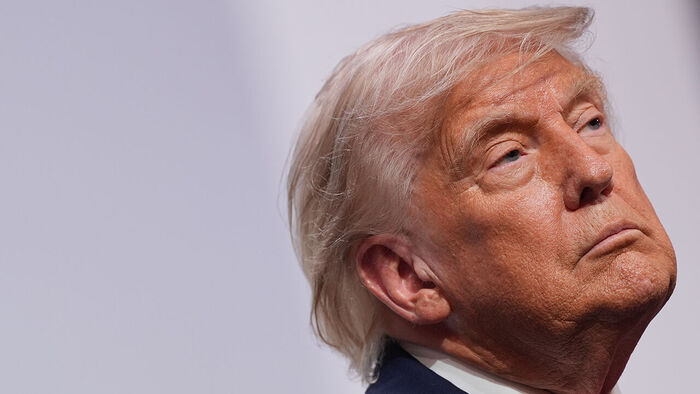
▲ President Donald Trump
It has been reported that U.S. President Donald Trump avoided answering a question on whether Iran would ultimately follow in North Korea's footsteps regarding nuclear development.
David Sanger, a reporter for the U.S. daily The New York Times (NYT), introduced a Q&A session he had with President Trump on June 14 in an article analyzing the Memorandum of Understanding (MOU) between the U.S. and Iran, published on June 18 (local time).
Sanger stated that he directly asked President Trump, who had called the NYT to announce the signing of the MOU, "Do you think Iran will now follow the North Korean model?"
The question was based on the concern that although Iran promised not to pursue nuclear development in the MOU with the U.S., its true intentions might be different.
The implication is that if the Iranian leadership becomes dominated by the perception that they were attacked because they lacked nuclear weapons, there is a risk that they could move toward nuclear development through concealment and deception, just as North Korea did.
Sanger pointed out that while Iran was attacked by the U.S. in June of last year and again this past February, President Trump has not threatened North Korea.
He also conveyed the U.S. intelligence community's assessment that North Korea succeeded in its first nuclear test in 2006 and now possesses approximately 60 nuclear weapons.
President Trump reportedly said, "He (Kim Jong-un) has serious nuclear weapons," adding, "That should never have been allowed to happen."
He then asked whether North Korea had acquired nuclear weapons during the Bill Clinton administration or the Barack Obama administration.
This appears to suggest his belief that North Korea developed nuclear weapons during Democratic administrations in the U.S.
North Korea's first nuclear test took place during the George W. Bush administration (2006), and there were five additional nuclear tests through 2017.
However, Sanger reported that President Trump did not answer the question regarding whether Iran would follow North Korea's path.
Nevertheless, President Trump insisted that this agreement would be able to deter Iran.
President Trump is highlighting the clause stating that Iran has agreed not to acquire or develop nuclear weapons as a key achievement of this MOU.
However, those who question whether Iran has a genuine will for denuclearization worry that Iran could secure the right to uranium enrichment for peaceful purposes from the U.S., eventually leading to nuclear development.
President Trump has also previously stated his position that he would allow enrichment for non-military purposes.
Since Iran has promised not to pursue nuclear development since joining the Treaty on the Non-Proliferation of Nuclear Weapons (NPT) in 1970, critics point out that what matters is not the promise itself, but Iran's proactive actions and thorough verification by the international community.
Some analysts suggest that while North Korea, which possesses not only nuclear warheads but also intercontinental ballistic missiles (ICBMs) capable of delivering them to the U.S. mainland, has not been attacked by the U.S., Iran—which only possesses highly enriched uranium—has become a target, likely causing hardliners within Iran to feel a desperate need for nuclear weapons.
(Photo: AP, Yonhap News)
※ Please note: This article was translated by AI and may contain errors.