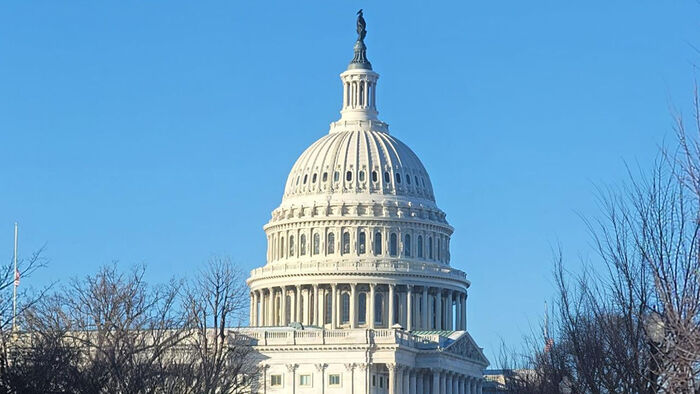
▲ The U.S. Capitol
It was confirmed on June 18 (local time) that the defense budget bill for the next fiscal year, which passed the U.S. Senate Armed Services Committee, includes a provision requiring the Secretary of Defense to regularly report on the roadmap for implementing the transition of wartime operational control (OPCON).
As the South Korean government accelerates the OPCON transition, the U.S. Congress has signaled its intent to scrutinize the implementation process more closely, drawing attention to how this will impact future discussions on the matter.
The National Defense Authorization Act (NDAA) for Fiscal Year 2027, passed by the Senate Armed Services Committee on June 11, requires the Secretary of Defense to submit a U.S.-South Korea roadmap report on implementing the bilateral "conditions-based OPCON transition plan"—signed on October 31, 2018—to the relevant standing committees every 90 days from March 1, 2027, through 2030.
The report must include assessments of the South Korean military's capability to lead combined defense, its ability to counter North Korea's nuclear and missile threats, and the security environment in the Indo-Pacific region.
Specifically, the bill stipulates that the report must include "status assessments by the Commander of the U.S. Indo-Pacific Command and the Commander of U.S. Forces Korea regarding the conditions that must be met before South Korea can responsibly assume OPCON."
This phrasing appears to reflect the Senate Armed Services Committee members' intent to consider the assessment of General Xavier Brunson, the current commander of U.S. Forces Korea, who has shown a subtle difference in stance compared to the South Korean government regarding the timing of the OPCON transition.
Ultimately, these provisions are interpreted as demonstrating the Congress's determination to continuously oversee the OPCON transition process through regular reports and assessments from the administration.
The NDAA passed by the Senate Armed Services Committee this time, similar to last year, contains a provision prohibiting the use of funds allocated under the bill for the OPCON transition process.
As with last year, a proviso was included allowing the use of funds 60 days after the Department of Defense submits a certification and assessment report to Congress. This report must verify that any reduction of U.S. Forces Korea or transfer of OPCON aligns with U.S. national security interests and that appropriate consultations were held with allies, including South Korea, Japan, and countries contributing militarily to the United Nations Command.
The difference is that while last year's NDAA specified that such certification was required only if the OPCON transition was carried out "in a manner that deviates from the mutually agreed plan," this year's NDAA removed that phrase and simply prohibited the use of funds to "complete the OPCON transition."
This can be interpreted to mean that even if South Korea and the U.S. proceed with the OPCON transition in accordance with their agreement, they must still undergo the certification and reporting process to Congress.
However, last year as well, the NDAA bill passed by the Senate Armed Services Committee initially stated only that funds could not be used to "complete the OPCON transition." It was later revised during the Senate-House reconciliation process to restrict funding only if the transition was completed "in a manner that deviates from the mutually agreed plan" in the final version of the NDAA.
The current NDAA, having passed the Senate Armed Services Committee, is now awaiting a vote on the Senate floor.
The NDAA, an annual bill that authorizes defense spending and policy, must pass both the Senate and the House. Any differing provisions are then reconciled to create a unified bill for final passage.
The NDAA passed by the House Armed Services Committee on June 4 differs from the Senate version, as it includes language prohibiting the use of funds to complete the OPCON transfer "in a manner that deviates from the mutually agreed plan."
The House is scheduled to vote on its version on the floor early next month.
Meanwhile, in its report accompanying the NDAA, the Senate Armed Services Committee expressed concern over the Chinese Communist Party's "malign influence" in South Korea. It directed the Secretary of Defense to submit a detailed report by May 1, 2027, on its impact on U.S. national security, including U.S. Forces Korea, and commercial interests.
(Photo: Yonhap News)
※ Please note: This article was translated by AI and may contain errors.