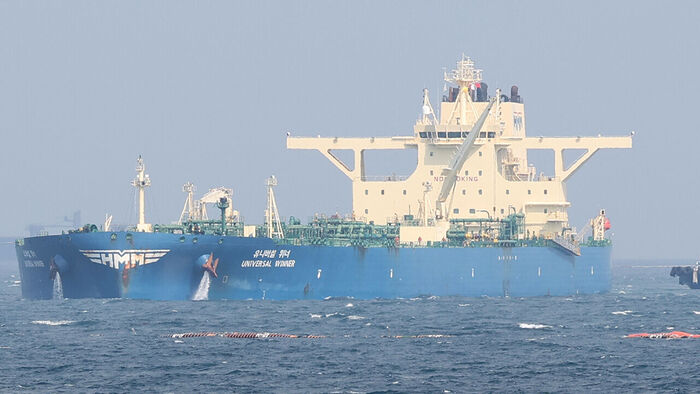
▲ The 'Universal Winner,' the first South Korean oil tanker to escape the Strait of Hormuz
Iran has reportedly begun accepting transit requests for vessels stranded in the Strait of Hormuz, following a ceasefire agreement with the United States.
Consequently, approximately 20 South Korean vessels trapped inside the strait are expected to apply to Iranian authorities to exit the area.
According to industry sources on Friday (June 19), the Persian Gulf Strait Authority (PGSA) of Iran has started accepting transit applications through its website.
This measure follows the decision to open the Strait of Hormuz in accordance with a memorandum of understanding (MOU) on ending hostilities with the U.S.
Article 5 of the MOU stipulates that Iran will take measures to ensure that vessels can safely transit the Strait of Hormuz without transit fees for 60 days upon the signing of the agreement.
In a statement released the previous day, Iran's Supreme National Security Council (SNSC) announced, "Merchant ships wishing to pass through the Strait of Hormuz must submit a transit request in advance through the PGSA," adding, "We plan to process submitted requests with the highest priority and speed to uphold the spirit of the MOU and achieve its goals quickly."
There are a total of 24 South Korean vessels currently stranded in the Strait of Hormuz.
It is reported that the shipping companies operating these vessels will individually apply to the PGSA to facilitate their exit from the strait.
The South Korean government plans to monitor the status of the shipping companies' applications while providing guidance through real-time communication to ensure safe navigation once the vessels begin their transit.
If the vessels in the Strait of Hormuz exit through the PGSA application process, they are expected to use alternative routes designated by Iran.
These routes are known to be relatively safe from the risk of sea mines laid by Iran.
It remains unclear when the vessels in the Strait of Hormuz, estimated to number as many as 1,000, will be able to leave.
The PGSA is expected to establish a plan based on the transit requests and provide guidance on departure times and routes.
(Photo: Yonhap News)
※ Please note: This article was translated by AI and may contain errors.