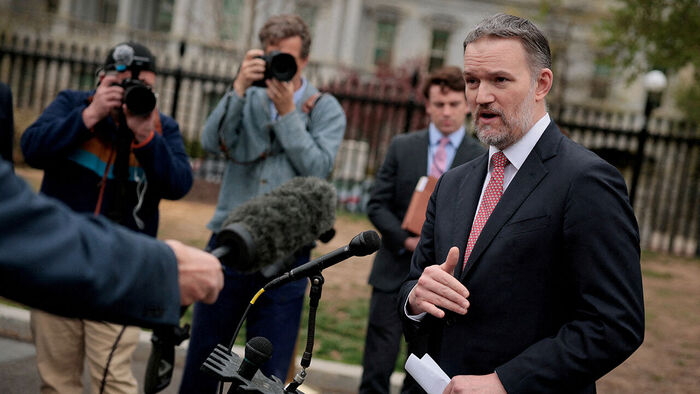
▲ USTR Representative Jamieson Greer
The Office of the United States Trade Representative (USTR) has launched a Section 301 investigation to determine whether Germany's pharmaceutical pricing policies are unreasonable or discriminatory toward U.S. pharmaceutical companies.
According to Bloomberg and Reuters, USTR Representative Jamieson Greer announced on June 18 (local time) that the agency would investigate whether Germany is paying excessively low prices for innovative medicines.
"I am particularly concerned by reports that Germany is rapidly advancing legislation to further reduce spending on innovative medicines," Greer said. "This is a serious step backward at a time when our trading partners should be paying their fair share to support research and development."
In April, Germany announced a reform plan to address a projected health insurance funding deficit of approximately 20 billion euros (35 trillion won), which includes measures to reduce pharmaceutical spending.
The investigation is being conducted under Section 301 of the U.S. Trade Act, which grants the administration the authority to respond—including through the imposition of tariffs—to foreign government policies and practices that are unjustifiable, unreasonable, or discriminatory and that burden or restrict U.S. commerce.
Previously, the USTR, citing Section 301, warned of potential tariffs of 10% or 12.5% on 60 economies, including South Korea, for "failing to sufficiently enforce bans on the import of goods produced with forced labor."
Reuters noted that depending on the outcome of this investigation into German pharmaceutical pricing policies, the U.S. could take trade actions, such as imposing tariffs on German imports.
It typically takes several months for such investigations to reach a conclusion.
Stephen Ubl, President and CEO of the Pharmaceutical Research and Manufacturers of America (PhRMA), stated in a press release that he supports the use of Section 301, adding, "We appreciate the administration's commitment to confronting unfair practices abroad."
(Photo: AP, Yonhap News)
※ Please note: This article was translated by AI and may contain errors.