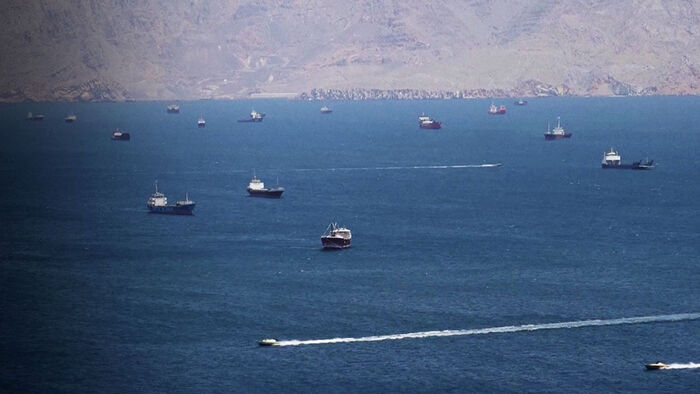
▲ Strait of Hormuz
The Omani Foreign Minister announced that he met with Iranian officials to discuss the Strait of Hormuz, reaffirming their commitment to upholding international law and ensuring safe, toll-free passage through the waterway.
Badr bin Hamad Al Busaidi, the Foreign Minister of Oman, stated on social media platform X on June 23 (local time) that he "welcomed Mohammad Bagher Ghalibaf, Speaker of the Iranian Parliament, and Abbas Araghchi, the Iranian Foreign Minister, in Muscat."
Al Busaidi added, "We held constructive discussions regarding the recently signed Iran-U.S. memorandum of understanding, particularly the provisions concerning the Strait of Hormuz. We reaffirmed our commitment to compliance with international law and ensuring safe, toll-free passage."
Mohammad Bagher Ghalibaf, who served as Iran's chief negotiator in previous talks with the U.S., and Foreign Minister Abbas Araghchi visited Oman, a mediator, immediately after returning from the first round of talks with the U.S. in Switzerland.
The Omani Foreign Minister's remarks appear to emphasize the principle that the Strait of Hormuz must remain open without the imposition of transit fees.
While the memorandum of understanding (MOU) between the U.S. and Iran includes a provision for Iran to take measures to ensure the passage of vessels through the Strait of Hormuz without tolls for 60 days, Iran has argued that it may collect funds under the guise of "fees" or "insurance premiums" once this period expires.
※ Please note: This article was translated by AI and may contain errors.