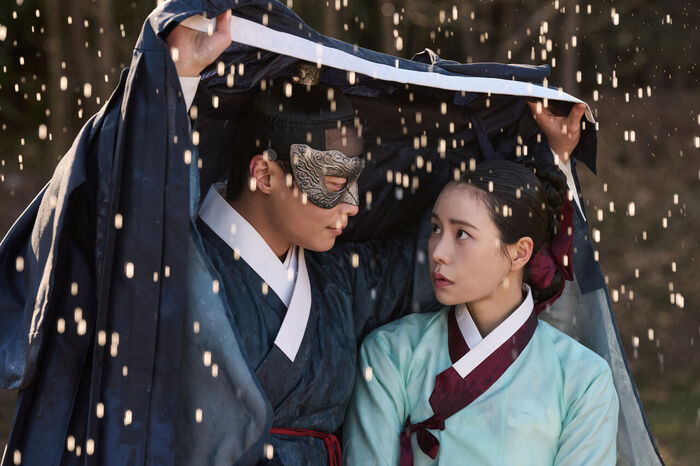
My Royal Nemesis (written by Kang Hyun-ju, directed by Han Tae-seop and Kim Hyun-woo), which concluded on the 20th, is a high-stakes romantic comedy. It follows the story of Shin Seo-ri (played by Lim Ji-yeon), an unknown actor possessed by the soul of a notorious Joseon-era villain, and Cha Se-gye (played by Heo Nam-jun), a cold-blooded conglomerate heir often called a monster born of capitalism. Throughout its run, the series captivated viewers with its tight plot, sophisticated direction, and stellar performances, even reaching number one on the Netflix global charts.
Notably, despite being a fantasy romance, My Royal Nemesis received rare acclaim from fans for its perfect historical accuracy. This stands in stark contrast to other contemporary dramas that faced controversy over historical distortion.
How did the production team build such a solid sense of reality on top of fictional elements like soul-swapping and time-travel? In a written interview released on the 30th, director Han Tae-seop and writer Kang Hyun-ju shared the details behind their meticulous process.
"The More Fantasy, the More Realistic": The Truth Behind the Red Comet from the Annals of the Joseon Dynasty
Director Han Tae-seop stated, "When I first read the script, I felt that for the fantasy elements to be convincing, the historical segments needed to be portrayed with depth and dignity. Therefore, I set the core principle of our historical research as 'implementing the classic beauty of the late Joseon Dynasty based on accurate historical records.'" He added, "We established motifs from specific historical periods and used clear artifact references for costumes and props. We minimized flashy or fusion-style elements to highlight a refined, understated, and classic aesthetic."
One of the most surprising details is the "Red Comet" that sets the story in motion. It was not merely a product of imagination but was rooted in actual historical records. Director Han revealed that he was inspired by a passage in the Annals of King Sukjong (Volume 10, 6th year of King Sukjong, November 1st), which reads, "A white vapor like a comet stretched from the west to the middle of the sky, and the comet appeared for two months." He explained, "This is presumed to be the 'Kirch Comet' of 1680, the first comet in human history observed with a telescope, which was also spotted in the West. We analyzed the characteristics of this comet group and reflected them in the visual design of our 'Red Comet'."
From Nakseonjae to Aeryeonji: Narratives of a Past Life Embedded in Space and Costume
The spatial design also carried the characters' narratives. The set for Lee Hyun's (Heo Nam-jun) quarters was modeled after the simple, unpainted dancheong of Nakseonjae Hall in Changdeokgung Palace, visualizing the loneliness of an outsider character who remains isolated even while living within the palace.
Director Han noted, "We placed traditional symbols throughout the set that connect the past and present lives." He continued, "To reflect the character's status as a Grand Prince, we decorated Se-gye's home set with bamboo, wooden pillars, and rain chains to subtly express Korean beauty. The square pond in the center of the house was modeled after Aeryeonji in the rear garden of Changdeokgung, incorporating the beauty of the palace the Grand Prince enjoyed in his past life."
Regarding the "Hee-bin Byeoldang" (private quarters) where Kang Dan-shim (Lim Ji-yeon) lived in the past, the director said, "We removed the flashy colors usually associated with 'Jang Hee-bin' and expressed it in a plain manner to emphasize Dan-shim's psychology—her loneliness and the way she endured the desolate order of the palace while longing for the Grand Prince."
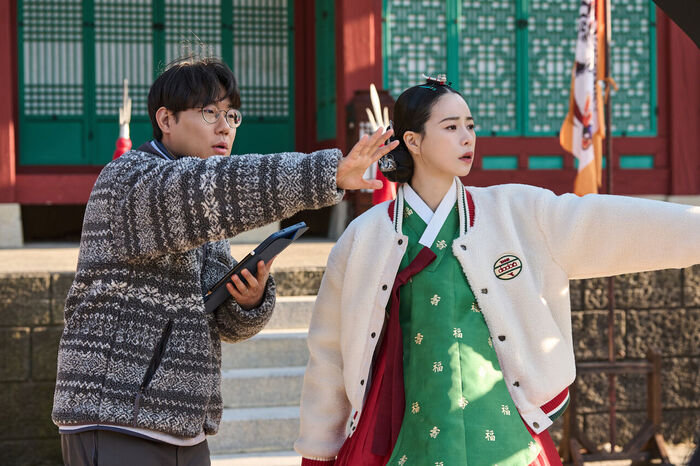
The costumes were also a culmination of craftsmanship. The green top and red skirt worn by Kang Dan-shim in the first two episodes were based on actual historical artifacts, undergoing multiple revisions to perfect the color combinations and embroidery. The team pursued the "beauty of emptiness," excluding excessive decoration in the hair accessories, the color combinations of the court lady uniforms, the thickness of the collar, and the width of the sleeves.
In particular, the Grand Prince's attire referenced the 2003 film Untold Scandal, often called the textbook for traditional Korean clothing, to preserve the authentic beauty of the era.
"A Worldview Grounded in Reality": A Victory of Collaboration
Writer Kang Hyun-ju shared her philosophy, stating, "Because we started with the dramatic premise of soul-swapping, the basic principle was to keep everything else as grounded as possible." The inclusion of names and idioms from historical figures like Shin Saimdang, Im Yunjidang, and Heo Nanseolheon in the early episodes was a calculated device to make viewers feel as though this fictional world were real.
Regarding the line Seo-ri shouted on a historical drama set, which became a hot topic for its critique of historical accuracy, the writer said, "I thought it was a natural comedic situation for a character who had flown from the Joseon era to the present to encounter a historical drama filming site. I approached it as a scene to maximize the character's personality and the situation, so I did not intend to imbue it with any further meaning," cautioning against over-interpretation.
Ultimately, the high-quality historical accuracy of My Royal Nemesis was a "victory of collaboration," made possible by the efforts of the director, writer, and the entire staff, including art, costume, and makeup teams. My Royal Nemesis remains a prime example of how compelling and persuasive a fantasy drama can be when supported by thorough historical research.
[Photo = SBS My Royal Nemesis]
Kang Sun-ae sakang@sbs.co.kr
※ Please note: This article was translated by AI and may contain errors.