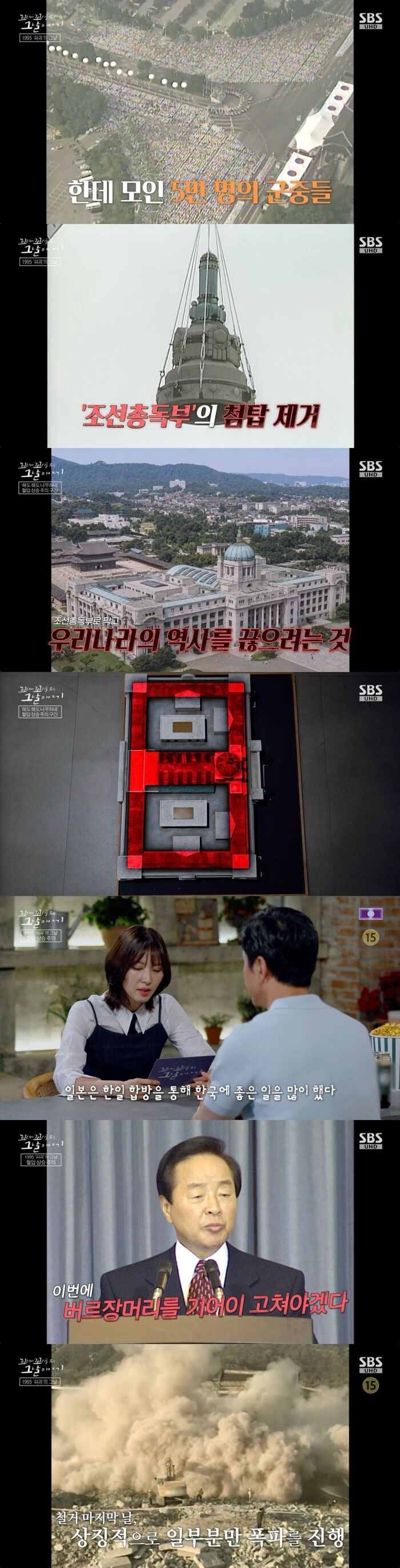
On the 16th, the SBS program "Tails of Tales" shed light on the day the Japanese Government-General building was demolished.
In the summer of 1995, 50,000 people gathered around the Gwanghwamun area. Although it was one of the hottest days of the year, no one complained or expressed irritation. What they were waiting for was the demolition of the spire of the Japanese Government-General building, a symbol of Japanese imperialism.
Although many had waited for this moment, the demolition was not a smooth process. At the time, opinions for and against the demolition were sharply divided, and at one point, the opposition to the demolition even held a majority.
Arguments against the demolition included the idea of preserving it as evidence of Japanese atrocities to serve as a lesson from a shameful history, as well as concerns over using taxpayer money for such a massive project when tearing down a building would not erase the painful past.
Additionally, there were opinions to preserve the building as it was a symbolic structure of modern Korean history that had changed owners four times over 70 years.
However, the president at the time, Kim Young-sam, was firm. Upon taking office, he ordered the prompt demolition of the Japanese Government-General building.
President Kim Young-sam argued for the demolition, stating, "While cultural assets should be preserved, can a symbol of national humiliation truly be considered a cultural asset?" and added, "Reforms cannot be achieved without setting history straight."
The Japanese Government-General building was a space deeply rooted in the intentions of Japanese imperialism, clearly designed to show the Korean people what Japan wanted them to see.
Above all, the building was constructed to block the view of Gyeongbokgung Palace, a symbol of the Joseon Dynasty, which sparked anger as it appeared to be an attempt to sever the history of Korea.
The construction took 11 years and cost 180 billion won. The building was created by exploiting the labor of Koreans and using Korean materials. It was a case of forcing Koreans to build the headquarters of their own colonial rule. Furthermore, Japan committed shameless acts to secure the massive construction costs, such as selling off Korean cultural assets.
For example, Seonwonjeon, where the portraits of Joseon kings were enshrined and ancestral rites were held, was sold off to be used as a kitchen and storage for a temple honoring Ito Hirobumi. In this process, Gyeongbokgung Palace was continuously damaged; out of 509 buildings that existed before the Japanese colonial period, only 36 remained after the period, meaning over 90 percent of the buildings were sold or demolished.
Japan even removed Gwanghwamun because it blocked the front of the Japanese Government-General building. They also designed the building so that its central axis was misaligned with that of Gyeongbokgung Palace, attempting to erase the legitimacy of the Korean people.
If the axis was tilted by 3.75 degrees, it pointed toward Namsan, where the Joseon Shrine, which enshrined Japanese deities, was located at the time. When viewed from above, the Japanese Government-General building looked like the Chinese character for "sun" (日), which represented Japan. This raised questions about whether it was Japan's true intention to stamp a "sun" seal in the very heart of Korea.
Despite this history of humiliation, even after the demolition was decided and the spire was removed first, the demolition did not proceed for a year. There were many tasks that needed to be completed before the full demolition.
In particular, the Japanese Government-General building was being used as the National Museum of Korea at the time. Moving the many artifacts without damage was a daunting task. A temporary relocation to the National Palace Museum of Korea, located 50 meters away, was decided, but for the officials who valued the artifacts more than their own lives, moving them was the most difficult challenge in the world.
During this process, something shocking was discovered in the basement of the Japanese Government-General building. A detention facility was found with iron doors as thick as 14cm. This space, which included locks on the outside and observation windows, served as evidence of the system Japan used to rule Korea. Traces of torture found throughout the space once again ignited public anger.
After the demolition was decided, Japanese people flocked to Korea to see the building before it disappeared. They made outrageous remarks, saying things like, "I miss those days; why destroy such a historically valuable building?"
In particular, the Japanese Minister of Internal Affairs and Communications sparked public outrage with his remarks, stating, "Japan did many good things for Korea through the annexation. The change of names was not forced."
In response, President Kim Young-sam countered, "I will fix the manners of the Japanese." He made his position clear, stating, "There is no reason for me to show tolerance regarding history."
As time passed, 11 months after the removal of the spire, the full-scale demolition began. The Japanese Government-General building was dismantled layer by layer and disappeared from the world forever on November 13, 1996.
Gwanghwamun Plaza has now become the most symbolic space in the Republic of Korea. If the Japanese Government-General building were still there, would it hold the same meaning it does today?
History was rewritten after the Japanese Government-General building vanished. Could the destruction on August 15, 1995, be considered a constructive destruction that allowed the Republic of Korea to be reborn?
※ Please note: This article was translated by AI and may contain errors.