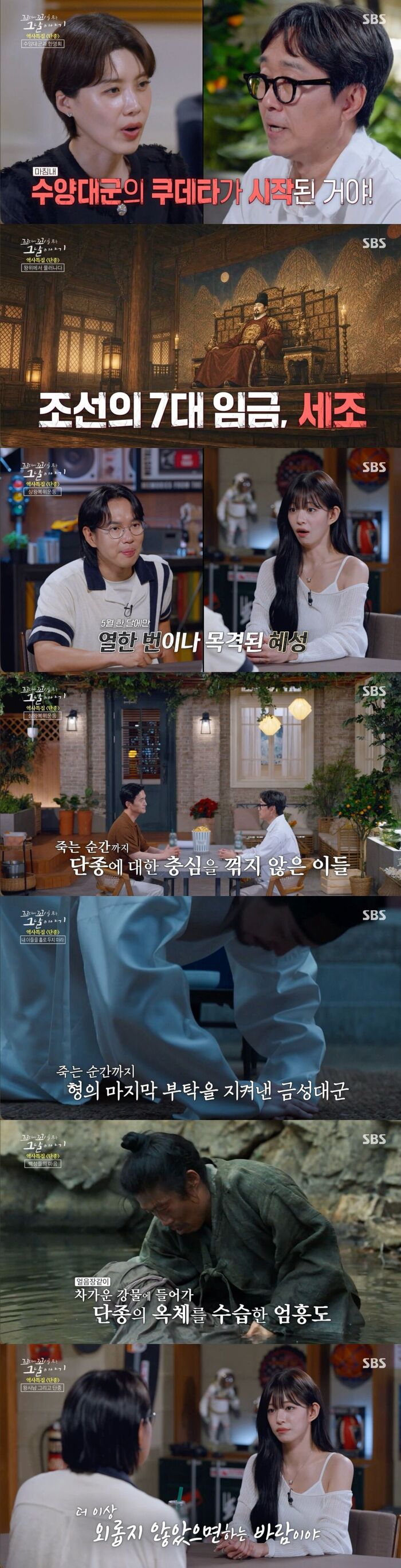
On the 6th, SBS program "Tails of Tales" traced the final story of the young king under the subtitle "Historical Special: Hongwi, Nosan, Danjong - Searching for the King's Name."
Djong is one of the most tragic figures in the Joseon Dynasty. Born into a flawless royal lineage spanning two generations, he ascended the throne at the age of twelve, only to be stripped of his crown just three years later by his uncle, Prince Suyang.
Prince Suyang, who seized the throne by staging the Gyeyujeongnan coup, appointed those who helped him as meritorious subjects, slaughtered the faction of Kim Jong-seo, and exiled Grand Prince Anpyeong. In this way, Danjong was reduced to a puppet king.
At the age of fifteen, Danjong realized that as long as he remained king, he could not prevent the sacrifice of his people, and he voluntarily stepped down from the throne. Consequently, Prince Suyang became King Sejo, the 7th monarch of Joseon. After becoming king, he ruthlessly purged those who supported Danjong.
In response, loyalists attempting to protect the young king risked their lives to plot a coup. However, bizarre omens appeared during the single month of May, including a comet sighting eleven times and a rice steamer in the royal kitchen making sounds on its own. Eventually, the coup was thwarted by King Sejo through the plotting of Han Myeong-hoe.
Fearing for their lives, those preparing the coup confessed the masterminds to King Sejo. King Sejo personally presided over the interrogation. Nevertheless, Seong Sam-mun and Park Paeng-nyeon resisted to the end. They addressed King Sejo simply as "Nae-uri" (lord) and refused to acknowledge him as king, leaving every single penny of the stipend he gave them untouched. In response, King Sejo ordered the punishment of dismemberment, tying the limbs and heads of the criminals to horse-drawn carts and pulling them in different directions.
Those who did not break their loyalty to Danjong until the moment of their death later came to be known as the Sayuksin (Six Martyred Ministers), though King Sejo at the time attributed the turmoil to the appearance of a comet and abnormal events.
Ultimately, King Sejo ordered Danjong's exile on the grounds that Danjong was behind the treason plot. Demoted from his position as King Emeritus to Prince Nosan, Danjong was no longer king.
Djong was sent into exile in Yeongwol, Gangwon Province, and suffered a heartbreaking separation from his wife. He sensed that he would never be able to leave Cheongnyeongpo until the day he died.
Even during such times, there was someone who did not forget the king. Remembering King Munjong's words not to leave his son alone, Grand Prince Geumseong plotted to restore Danjong to the throne. However, even this plan was discovered, and Grand Prince Geumseong was sentenced to poison.
Before receiving the poison, when ordered to bow toward the king, he bowed toward the north where Danjong was staying, drank the poison, and fulfilled his older brother's request until his final moment.
According to the Annals of King Sejo, Prince Nosan heard this news, hanged himself, and was buried with proper rites. However, most of the folk tales remaining in Gangwon Province recorded that he was killed by officials sent to execute him.
The records in the later-compiled "Yeollyeosil Gisul" mention Wang Bang-yeon, an official of the Uigeumbu (Royal Tribunal), who visited with the poison sent by King Sejo.
It was also recorded that "a tongin (low-ranking government clerk) always attended to Nosan, volunteered to do the deed himself, tied a long string to a bowstring, and pulled it from the window behind Nosan's seat."
While the Annals of King Sejo recorded that Danjong died by suicide, all other records stated that he was murdered. Though details varied slightly, they all consistently agreed that King Sejo sent the poison.
History is written by the victors. Therefore, it was the task of historians to examine the records of the victors and historical anecdotes to determine what came closest to the truth.
The body of the boy who was once the king of Joseon was later discarded in the Donggang River. Eom Heung-do, who had cared for him in Yeongwol, came out of his house with his three sons early the next morning, recovered Danjong's remains, held a funeral, and then parted ways with his sons.
He was a man who stated that he would gladly accept death for the sake of righteousness, and he protected his king to the very end.
Eom Heung-do was not the only one who protected the king. Even after Eom Heung-do departed, the people of Yeongwol devotedly tended to the tomb of Nosan.
Djong was eventually reinstated as king by King Sukjong, the 19th monarch of Joseon, and was given the temple name Danjong. The name was chosen to signify upholding decorum and holding fast to righteousness. This took place 241 years after Danjong passed away.
With Danjong's reinstatement, history was rewritten, his wife Lady Song was posthumously honored as Queen Jeongsun, and the Sayuksin established themselves as symbols of loyalty and fidelity. Furthermore, Eom Heung-do was appointed to the rank of Minister of Public Works and bestowed with the posthumous title of Chungui-gong.
569 years after Danjong's death, if one were to express his life in a single word, it would be the lonely king. However, in the present day, many people trace his footsteps, remember him, and feel sorrow for him. The hope is that he will never be lonely again.
Moreover, history should no longer repeat the tragedy where the vulnerable are unfairly sacrificed for someone else's ambitions.
※ Please note: This article was translated by AI and may contain errors.