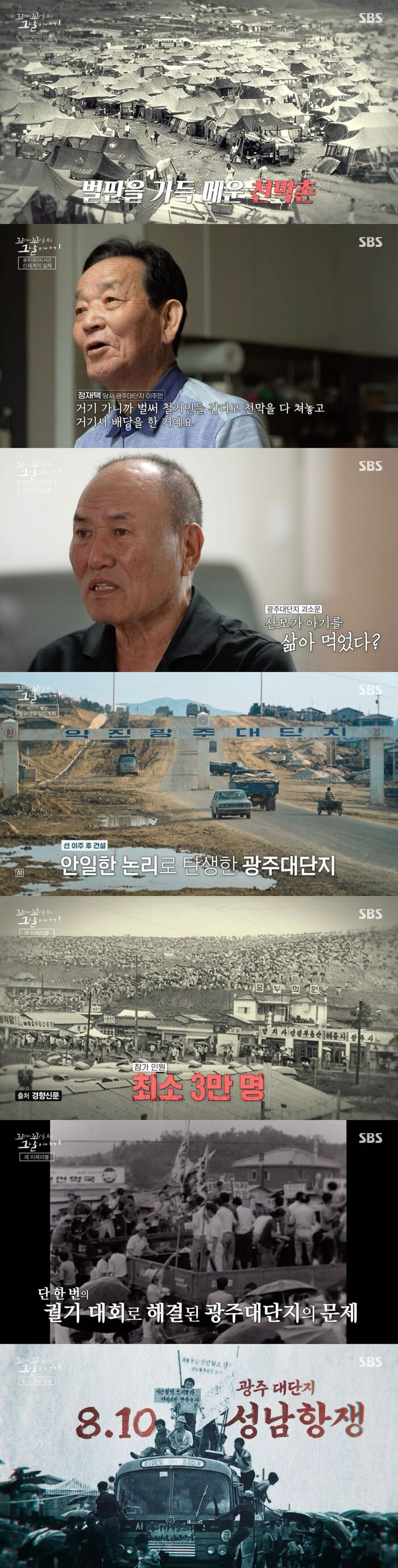
On the 27th, the SBS program "Tails of Tales" shed light on the events that took place in the Gwangju New Town area of Gyeonggi Province under the subtitle "Shadow City - The 1971 Gwangju New Town Incident."
During the Park Chung-hee administration, Mayor Kim Hyun-ok, nicknamed the bulldozer, demolished shanty towns across Seoul for urban redevelopment and relocated residents to the Gwangju New Town in Gyeonggi Province.
Carried out under a policy of relocation first and development later, the resettlement site lacked basic infrastructure, running water, and electricity, with no places for residents to find work. People who had left impoverished areas ended up living even harder lives.
Enduring a harsh existence, these residents had to fight off disease. At some point, rumors began to spread. An urban legend circulated claiming that a mother, suffering from severe hunger, had boiled and eaten her own newborn baby.
Having left behind shanty towns, what awaited them were tent cities, and the population here soon swelled to 40,000 residents. However, Mayor Kim reportedly expected residents to fend for themselves, stating that if you gather about 100,000 people, they will figure out how to survive on their own.
Later, following the collapse disaster of the Wow Apartment, Mayor Kim Hyun-ok, the creator of South Korea's first quick-built apartments, stepped down from his position.
Meanwhile, Cha Ji-cheol, who harbored ambitions of entering the National Assembly, made campaign promises to complete the construction project within two years, distribute land for free, and abolish taxes for five years. He won overwhelming support and became a lawmaker.
At the time, Gwangju New Town was considered a utopia. Consequently, land prices rose every day, prompting people dreaming of owning a home to empty their life savings to buy land there. However, the Seoul Metropolitan Government announced a total ban on the trading of pre-sale rights, imposing a penalty of four to eight times the original purchase price on those who transferred their properties. Furthermore, they demanded that this amount be paid in a lump sum within a fortnight of the notice.
As if paying for the land twice was not enough, residents now faced fines amounting to 67 times the land purchase price. Moreover, contract conditions that stated failure to move in and settle within 30 days of receiving a lot would invalidate the allocation and the land would be given to someone else were concealed, exploiting innocent residents.
Winter was exceptionally harsh on them. As a result, deaths were reported one after another from various places, and the heartbreaking story of a deceased mother fueled the spread of cannibalism rumors.
Eventually, residents formed an organization to fight for their rights and asked the Seoul Metropolitan Government to provide jobs for the impoverished, emergency relief grain, lower prices per pyeong, and permission for installment payments. However, the Seoul Metropolitan Government remained silent, and to make matters worse, Gyeonggi Province even levied acquisition taxes.
Furious, the residents formed a struggle committee and led a residents' rally. However, the government dismissed their requests with irresponsible remarks such as, "Who asked you to come and live here? If you don't like it, leave."
Enraged by this, at least 30,000 residents gathered to voice their anger and shout slogans, waiting to negotiate with the Mayor of Seoul. However, the mayor failed to show up by the promised time, and at that moment, a torrential downpour began. The residents' anger crossed its tipping point, and the atmosphere at the site grew increasingly severe.
Residents occupied buses and headed toward the Blue House. However, they could not proceed further because government officials blocked their path. The residents had to return home without achieving anything.
Just then, news broke that negotiations between the Mayor of Seoul and resident representatives had reached a breakthrough. After a single rally, the Seoul Metropolitan Government agreed to meet the residents' demands.
In fact, the government had been fully aware of the problems in Gwangju New Town a year prior. Yet, because of money, they had failed to take any action.
Gwangju New Town had been sacrificed for the development of Seoul. Only Seoul profited at the expense of the shanty town residents. This led to the assessment that it was developed as "front yard development for Gangnam, back yard development for Gwangju New Town."
The government paid no attention to Gwangju New Town because it was a destination for the vulnerable, and they were satisfied with banishing poverty from Seoul. Gangnam and Gwangju New Town were the light and shadow of South Korea's development.
Following the residents' rally and the dramatic settlement of their demands, some authorities singled out the leaders, subjecting them to torture and pressure. Even after being acquitted later, detectives continued to monitor them. This was done out of fear by a government that residents might organize once again.
For a long time afterward, Gwangju New Town residents could not proudly state where they lived. That was because the area had suddenly become known as land belonging to impoverished subversives.
In 2024, this rally officially came to be known as the "August 10 Gwangju New Town Seongnam Uprising." It has been evaluated as the first large-scale urban poor struggle to demand the right to survival since the establishment of the South Korean government. It was the ultimate desperate resistance by those who had nothing.
However, if the government had kept its promises from the beginning and had not turned a blind eye to the grim reality, the events of that day would not have happened.
Poverty still exists in South Korea today, and similar incidents have repeated themselves. Yet, it has drawn attention as people continue to endure day by day thanks to those who help, understand, and stand by one another.
※ Please note: This article was translated by AI and may contain errors.