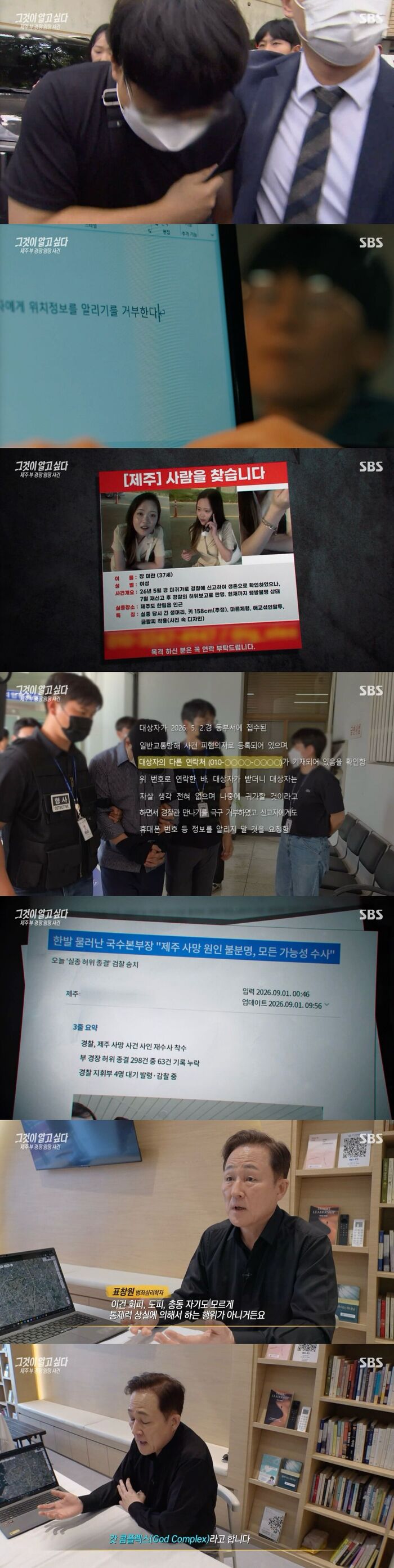
On the September 19 broadcast of SBS's "Unanswered Questions", the program tracked down Officer Bu, who falsely closed a missing persons case in Jeju.
On May 12, 36-year-old Jang Mi-ran disappeared after leaving her home. Her family and boyfriend filed a missing persons report, but she was ultimately found skeletal in a palm tree grove in Hallim-eup, Jeju City, 104 days after her disappearance. Shockingly, the palm grove was located just 400 meters away from her lodging.
Her boyfriend had reported her missing following her disappearance. The officer on duty at the time was Officer Bu from the Missing Persons Investigation Team at Jeju Seobu Police Station, who called back just two and a half hours after receiving the report, claiming he had made contact with Mi-ran. He informed the boyfriend that Mi-ran did not want her location disclosed to him, and announced that he was closing the case.
However, this was a lie. Even several days after the missing persons report, no one had been able to reach Mi-ran, prompting her family to file another report, which unraveled Officer Bu's deception.
Police had never actually spoken with Mi-ran following her disappearance; Officer Bu had falsely processed her as deceased in the internal police missing persons system, deleting the report record.
Yet this was not the only case Officer Bu had falsely closed. In June, Officer Bu handled a missing persons report for a man in his 60s in the exact same manner. Public fury erupted as his incomprehensible conduct came to light, revealing that Officer Bu had Distorted details or falsely closed as many as 25 missing persons reports.
Furthermore, on the day Mi-ran's remains were discovered, police prematurely announced her cause of death as hanging, suggesting she had taken her own life—even before an autopsy had been conducted.
However, because Mi-ran was found in a skeletal state, even an autopsy could not determine a definitive cause of death, nor were there clear clues pointing to how she died. Despite this, police had rushed to announce a cause of death.
These police actions ultimately fueled numerous suspicions. Questions were raised regarding cell tower locations during the early days of her disappearance and CCTV sightings, as well as skepticism over whether it was even possible to hang oneself from a palm tree using shoelaces.
Through experiments, the production team confirmed that the possibility of incomplete hanging could not be ruled out. However, this finding alone was insufficient to determine whether her death was a suicide or homicide. The broadcast emphasized that hasty speculation and assumptions must be avoided all the more.
Regarding Officer Bu, police stated, "Profiling analysis suggests that a motive of work neglect, amid fatigue from accumulated workload and mounting responsibilities, combined with the suspect's avoidant and irresponsible attitude, led to the crime of falsely closing the cases."
However, attributing his actions merely to laziness raised eyebrows, as Officer Bu demonstrated meticulous calculation in the case of the man in his 60s by searching through other case files to find contact numbers and reach out.
In response, a criminal expert stated, "This is not an act driven by avoidance, escape, impulse, or an unconscious loss of control. He took extremely selective, proactive, and deliberate actions. He deliberately made it impossible to locate the missing persons, and we must uncover why Officer Bu did such a thing."
The expert drew further attention by adding, "Committing criminal acts using one's position or authority to gain a sense of superiority and satisfaction, as if one were a god, is referred to as a 'God complex.' The most notorious example is Britain's Harold Shipman, who killed patients he deemed unworthy of life by injecting them with poison."
Finally, the broadcast emphasized that while Officer Bu turned numerous missing persons cases into cold cases, he is not solely to blame for turning them into suspicious deaths.
※ Please note: This article was translated by AI and may contain errors.