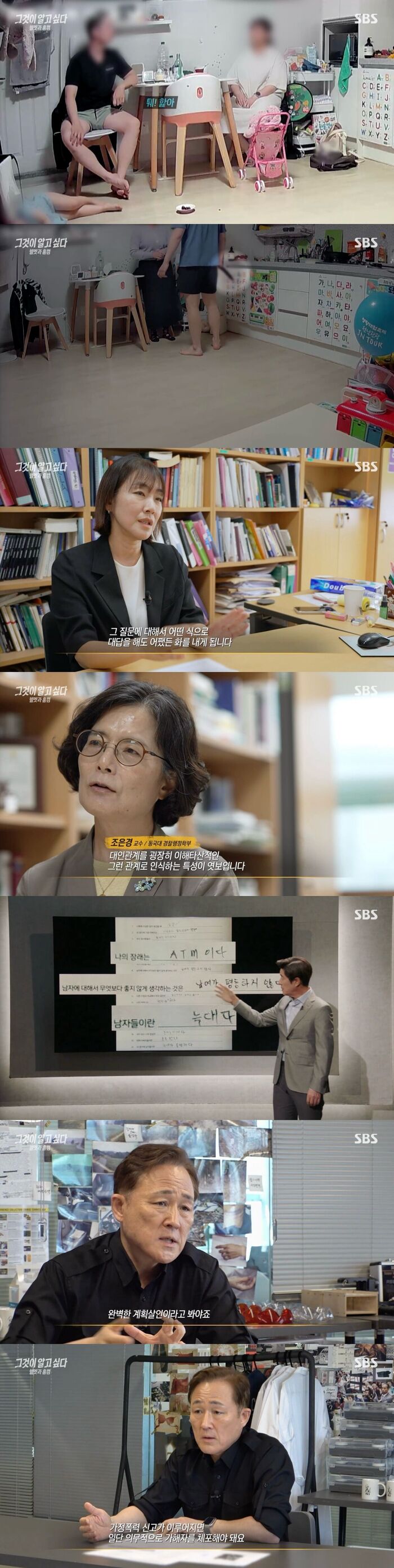
The October 3 broadcast of SBS's "Unanswered Questions" delved into the murder case involving a public official in Gwangju.
On September 1, a woman leaving her multi-family home in Gwangju, Gyeonggi Province, to take her five-year-old child to daycare met a gruesome death. The person who indiscriminately attacked her in front of her young daughter was none other than her husband, identified by his surname Yeom.
Wearing a helmet and lying in wait on the stairs, Yeom stabbed the 34-year-old victim with a weapon in 28 different places before fleeing on the motorcycle he had arrived on.
Yeom, a public official married for five years, was apprehended just four hours after fleeing. His acquaintances speculated that the act was an impulsive crime triggered by the sudden divorce lawsuit, remarking, "He never showed any violent tendencies. Something we don't know about must have driven him crazy."
Yeom likewise claimed that his crime was provoked by the stress of the divorce lawsuit.
Eun-ah's family also never anticipated that Yeom would resort to murder. In an attempt to understand why he carried out such a brutal act, they searched for a USB drive containing evidence Eun-ah had previously gathered for the divorce. Eun-ah's younger sibling managed to locate the drive in her home after much effort.
Over 4,000 home cam video files were stored on the USB drive. In addition, around 600 audio files remained on her mobile phone. After reviewing the home cam footage alongside the production team, Eun-ah's sibling drew attention by stating, "Strangely, I don't feel angry. I just feel so sorry for my sister."
In the home cam footage, Yeom appeared completely different from how his acquaintances had described him. He frequently vented his dissatisfaction toward the victim over financial issues. In particular, he obsessively fixated on trivial amounts of a few thousand or even a few hundred won, hurling verbal abuse and making threats.
In response, the victim secretly contacted the police, and with police assistance, she was finally able to be separated from Yeom along with her child. Furthermore, after Yeom was taken away by the police, the victim returned home, erased all clues on Yeom's phone that could be used to track her whereabouts, and escaped.
However, the victim's residential address was subsequently exposed in the divorce complaint sent to Yeom, leading him to track her down and brutally murder her.
The two met in a social club and dated before starting a family after expecting a child. Yeom stopped holding back his dissatisfaction once the victim took childcare leave. This escalated into disputes over money, with Yeom speaking of marriage and childbirth as if they were someone else's concerns, declaring that getting married in the first place had been a mistake and blaming everything on the victim.
Drinking after work had become a habit for Yeom, who picked fights over trivial matters, used abusive language, and on some days even threatened the victim with a weapon. Consequently, the victim visited a police station for a consultation. At the time, the police recommended filing a formal case, but the victim chose only to receive counseling—a decision presumed to stem from consideration for Yeom, who was deeply obsessed with maintaining his civil servant status.
Analyzing their conflicts, an expert stated, "He starts with small, specific issues, interrogates the victim, and gets angry no matter how she answers. The questions already have predetermined answers, serving merely as an outlet to vent his anger at her. The victim simply listens, enduring the perpetrator's one-sided outburst."
The expert also pointed out, "He constantly calculated profits and losses, and money accounted for the highest proportion of what he cited as sacrifices. The perpetrator seems to have viewed marriage as a contract rather than love." Indeed, Yeom claimed he gained nothing from the marriage and blamed everything on the victim.
The expert added, "Their conversations were entirely one-sided. The perpetrator rampaged alone, hurling verbal abuse and digging for pretexts to induce shame in the other person. Meanwhile, the victim patiently endured it, likely for the sake of their child."
Yeom was said to have been a good father only to his child. However, one day during an argument with the victim, when the child began crying, he irritably threw the child onto the floor and closed the door. When the child cried intensely, Yeom once again hurled the child to the floor. Seeing Yeom harming their child, the victim could no longer endure it, gathered great courage, and called the police. This incident ultimately drove her decision to pursue a divorce.
Regarding the perpetrator Yeom, the expert remarked, "He exhibits a tendency to perceive interpersonal relationships in purely calculated terms. With shallow emotionality, he may suffer from a lack of unconditional love—both in giving and receiving affection without conditions." The expert added, "He reportedly cut ties almost completely with his parents. While it is unclear what issues existed during his childhood, his mindset suggests that if someone causes him harm, he is willing to resent and blame even his own parents."
The production team visited Yeom's parents in person. His mother stated that she had lost contact with her son for quite some time and knew little about the specific circumstances of the incident. However, she defended him, saying, "Before he got married, he was truly a good son and worked very hard."
Yeom's father revealed that he had been unable to care for his son properly due to financial struggles, and that Yeom had contacted him after the incident. The father stated that Yeom committed the crime after the victim refused to let him see their daughter, adding, "When he drank, he became a lunatic. So he went there fully intending to kill her. He must accept and face punishment for what he did wrong."
The victim ran the household and cared for their child on the 750,000 won per month provided by Yeom. Yeom controlled the victim's spending down to increments of 100 won. Yet he never gave up alcohol or cigarettes and regularly attended the gym.
The perpetrator believed that men and women were not equal, that his future would be reduced to that of an ATM, and that men were pitiful. Claiming that he was the victim and the one making sacrifices, he placed all the blame for the divorce on his wife. In particular, he insisted that he had made nothing but sacrifices through marriage.
On this, the expert commented, "Yeom effectively purchased a wife with money. He vented the self-pity and resentment accumulated since childhood by drinking every night after marriage to relieve stress."
The expert further pointed out, "What was most important to the perpetrator was his status as a public official." Yeom acted like a sacrificing family provider on the outside while reigning like a king at home. It was revealed that those around him were entirely unaware of his double life.
After being separated from the victim, Yeom immediately worried about disciplinary action from the postal service; he badmouthed the victim to a colleague and even considered hiring a private detective agency to track down her location.
Furthermore, he complained about the money he had spent on the victim, saying, "If I die alone, all 200 million won will go to my wife, which feels unfair." He then ominously stated that he would never die alone.
Yeom flew into a rage after receiving a standard divorce complaint. The expert analyzed, "It must have been a shock to him. Thinking, 'Would she really go that far?', he likely never believed the victim would actually abandon him. Underlying this was the mindset that if they divorced, he must never suffer a loss." The expert continued, "The biggest reason he refused to accept the divorce seems to have been his worry over money, division of assets, alimony, and child support. He likely feared that if the matter went to a divorce trial, his workplace would find out, a disciplinary committee would be convened, and he would lose his status as a civil servant."
Regarding the reason why he waited two weeks before committing the crime after learning the victim's residential address from the divorce complaint, the expert analyzed, "He seems to have checked her movement routes, daily habits, whether she lived with anyone, and whether she was under police protection, all to execute a meticulously planned murder."
In fact, before the murder, Yeom had told a colleague that he confirmed the victim's sibling was not living at her residence.
In the audio recording of the final conversation with the victim before her death, Yeom appeared emotionally agitated when she told him she would come to retrieve her belongings accompanied by police officers.
The expert observed, "When the victim says, 'I don't want to see you,' the perpetrator lets out a hollow laugh. His emotional state shifts drastically at that moment, seemingly thinking, 'This isn't going to work.'"
The expert added, "During the separation period, the perpetrator drank alone every day and focused obsessively on various thoughts. He appears to have experienced an escalation of aggressive impulses fueled by growing resentment and blame toward the victim."
The expert also expressed deep concern for the victim's young daughter, noting, "When the perpetrator's violent outbursts began, the child exhibited a freezing response out of anxiety. It was as if she momentarily retreated to another world in an apparently calm state." The expert elaborated, "Even before the separation order, when the perpetrator was hugging the child, she remained frozen; only upon being released did she act as if waking up, calmly packing her toys. It appears the child was exposed to an environment where such violence was pervasive. Thorough treatment seems absolutely necessary."
The victim reported him to the police four times, yet the state failed to protect her. In response, an expert emphasized, "Once a report of domestic violence is made, arresting the perpetrator should be mandatory. Police should not ask the victim. The victim is in no position to make such a choice." The expert added, "To him, the predetermined rule was that his position as a postal civil servant must never be jeopardized."
Following the victim's reports, the police implemented protective measures according to manual guidelines, but in reality, these measures proved ineffective.
The expert voiced urgent concern, stating, "Historically in our country, domestic violence cases have been handled with a priority on preserving the family unit. There has been a practice of taking no action and merely observing if the victim states they do not wish for punishment, but police should have the authority to arrest and open a formal criminal case on their own initiative." The expert called for institutional reforms that reflect the unique nature of domestic violence.
Under current procedures, personal information in divorce complaints is protected only if a prior redaction request is filed. Addressing this, the expert pointed out, "This divorce complaint was filed alongside a lawyer. Even so, her address was exposed. If it is a system where even professionals can miss it, then the institutional setup itself is fundamentally flawed."
Yeom's father also lamented the critical flaw in the existing system, saying, "This could have been prevented. Why would the victim's address be disclosed? If he hadn't known where she lived, he wouldn't have been able to kill her even if he wanted to."
Currently, a proposed legislative amendment allowing the court to redact victim information ex officio has been introduced, but it remains pending.
Finally, the broadcast drew attention by offering words of solace to those facing similar situations to the victim: "We hope this does not leave you with the helpless feeling that running away is futile." The show expressed confidence that society will soon establish definitive measures to protect individuals seeking a safe separation.
※ Please note: This article was translated by AI and may contain errors.
(SBS Entertainment News | Kim Hyo-jung)