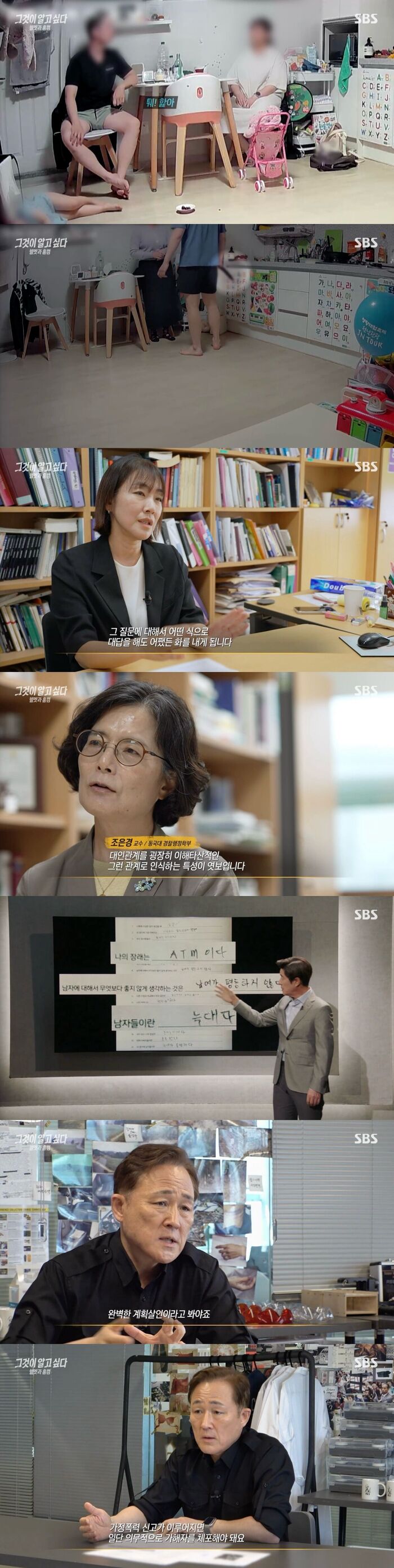
The October 3 broadcast of SBS's "Unanswered Questions" delved into the murder case involving a public official in Gwangju, Gyeonggi Province.
On September 1, a woman leaving her home in a multi-unit residence in Gwangju, Gyeonggi Province, to take her 5-year-old child to daycare met a gruesome death. The person who indiscriminately attacked her in front of her young daughter was none other than her husband, Mr. Yeom.
Lurking on the stairs wearing a helmet, he stabbed the 34-year-old victim, Park Eun-ah, in 28 places with a weapon before fleeing on the motorcycle he had arrived on.
Yeom, a civil servant married for five years, was apprehended just four hours after his escape. His acquaintances speculated that it was an impulsive crime triggered by an unexpected divorce lawsuit, stating, "He never showed any violent tendencies. Something we don't know about must have driven him crazy."
Yeom also claimed regarding the crime that it was driven by stress caused by the divorce proceedings.
Eun-ah's family had never anticipated that Yeom would go so far as to commit murder. To find out why he carried out such a horrific act, her younger brother searched for a USB drive containing evidence Eun-ah had previously gathered for the divorce. After a difficult search, he managed to recover the drive from Eun-ah's home.
The USB drive stored around 4,000 home camera video files. In addition, around 600 audio recordings were found on her phone. After reviewing the home camera footage with the production team, Eun-ah's brother caught attention by saying, "Strangely, I don't feel angry. I just feel so deeply sorry for my sister."
In the home camera footage, Yeom appeared completely different from how his acquaintances had described him. He constantly vented his frustrations at the victim over financial issues. In particular, he obsessively fixated on mere sums of a few hundred or a few thousand won, verbally abusing and threatening the victim.
Eventually, the victim reported him to the police without Yeom's knowledge, and with police assistance, she was finally separated from him along with their child. Furthermore, after Yeom was taken in by officers, the victim returned to the house, deleted all clues from Yeom's phone that could track her new whereabouts, and escaped.
However, the victim's residential address was later exposed in the divorce complaint served to Yeom, leading him to track her down and brutally murder her.
The two had met through a small social gathering and started a family after having a child together. Yeom stopped holding back his complaints once the victim took childcare leave. This escalated into financial friction, and Yeom spoke of their marriage and childbirth as if they were someone else's business, blaming everything on the victim and claiming that getting married in the first place was a mistake.
Drinking after work had become a daily habit for Yeom, who picked fights over trivial matters, hurled verbal abuse, and on some occasions even threatened the victim while brandishing a knife. The victim visited a police station for counseling. At the time, the police recommended filing an official report, but the victim only sought counseling. This was presumed to be out of consideration for Yeom, who was deeply obsessed with his status as a public servant.
An expert analyzed their conflicts, saying, "He begins with small, specific matters, poses questions to the victim, and gets angry no matter how she answers. These are questions with predetermined answers, functioning purely as an outlet to take his anger out on her. The victim simply listens, enduring the perpetrator's one-sided venting."
The expert added, "He constantly calculates gains and losses, and among the sacrifices he mentions, money makes up the largest portion. The perpetrator seems to have viewed marriage not as love, but as a contract." Indeed, Yeom repeatedly blamed the victim for everything, claiming he had gained nothing from their marriage.
The expert continued, "Their communication was completely one-sided. The perpetrator raged alone, shouted verbal abuse, and dug for vulnerabilities to humiliate his partner. Meanwhile, the victim endured it patiently, likely for the sake of their child."
Yeom was said to have been a good father only to his child. However, one day during an argument with the victim, when the child started crying, he irritably threw the child onto the floor and slammed the door shut. When the child began crying intensely, Yeom once again hurled the child to the floor. Witnessing Yeom harming their child, the victim finally could no longer endure it, mustered immense courage, and contacted the police. This incident ultimately led to her decision to file for divorce.
Analyzing the perpetrator Yeom, an expert pointed out, "He has a tendency to perceive interpersonal relationships in purely transactional terms. He possesses shallow emotionality, and one might suspect a deficiency in experiencing unconditional love—both in giving and receiving selfless affection." The expert added, "He is said to have virtually cut ties with his parents. While it is unclear what issues existed in his childhood, his mindset suggests that if his parents cause him any harm or inconvenience, he feels justified in resenting and blaming them as well."
The production team went directly to meet Yeom's parents. His mother stated that she had been out of contact with her son for quite some time and did not know the detailed circumstances of the incident. Defending her son, she said, "Before he got married, he was truly a kind son who worked hard in life."
Yeom's father revealed that he had been unable to look after his son properly due to financial hardships, adding that Yeom had contacted him after the crime. The father claimed that Yeom committed the act because the victim refused to let him see his daughter, stating, "When he drank, he became a lunatic. That's why he went there determined to kill her. He must receive punishment for his wrongdoing and accept it."
The victim managed the household and cared for the child on just 750,000 won per month provided by Yeom. Yeom scrutinized every expenditure she made down to the last 100 won. Yet, he never gave up alcohol or cigarettes and consistently attended the gym.
The perpetrator believed that men and women were not equal, viewed his future merely as an ATM, and claimed men were pitiable. Painting himself as the victim and martyr, he blamed his wife entirely for the divorce, claiming he had made nothing but sacrifices through marriage.
An expert remarked, "Yeom essentially bought a wife with money. The self-pity and resentment built up since his childhood were released every night after marriage through drinking to relieve stress."
The expert also pointed out, "What mattered most to the perpetrator was his status as a public servant." While presenting himself outside as a self-sacrificing head of the family, Yeom ruled like a king at home. Those around him were completely unaware of this double life.
Following the separation order, Yeom worried first and foremost about disciplinary action from the postal service, badmouthed the victim to a colleague, and even contemplated hiring a private investigation agency to track down her location.
Furthermore, he remarked, "If I die alone, 200 million won goes entirely to my wife, which feels so unfair," expressing resentment over the money he had spent on her. He then made the ominous remark that he would never die alone.
Yeom went into a frenzy after receiving the standard divorce complaint. An expert analyzed, "It must have been a shock to him. Thinking, 'Would she really go that far?', he seemed unable to believe she would genuinely abandon him. Beneath that was the mindset that if a divorce were to happen, he must never suffer a loss." The expert continued, "The biggest reasons he could not accept the divorce appear to be worries over money, property division, alimony, and child support. He likely feared that if the case went to a divorce trial, it would become known at his workplace, trigger a disciplinary committee, and cost him his public servant position."
Regarding why Yeom did not commit the crime for two weeks after learning her residential address from the divorce papers, the expert analyzed, "He appears to have verified her routes, daily habits, whether anyone was living with her, and whether she was receiving police protection in order to execute a premeditated murder."
In fact, before the murder, Yeom told a colleague that he had confirmed the victim's brother was not staying at her residence.
In the final recorded conversation between the victim and Yeom before her death, Yeom appeared emotionally agitated when the victim stated she would come to retrieve her belongings accompanied by police officers.
An expert analyzed, "When the victim says, 'I don't want to see you,' the perpetrator lets out a dry, mocking laugh. His demeanor shifts dramatically right at that moment, as if realizing, 'This isn't going to work.'"
The expert further noted, "During the separation, the perpetrator drank alone every day and focused obsessively on various thoughts. He likely experienced an escalation of aggressive impulses fueled by growing resentment and blame toward the victim."
The expert also expressed deep concern for the victim's young daughter, noting, "When the perpetrator's violent outburst began, the child displayed an immobility response out of anxiety. It was as if she momentarily retreated into another world in a state of calm." The expert continued, "Even before the separation, when the perpetrator held the child tightly, she remained frozen, and once released, she was able to casually gather her toys as if waking up. This suggests how deeply pervasive violence was in the child's environment. Intensive therapy appears absolutely necessary."
The victim had reported him to authorities four times, yet the state failed to protect her. An expert criticized, "When a domestic violence report is filed, arresting the perpetrator must be mandatory. Authorities should not ask the victim. The victim is in no position to make such a choice," adding, "The predetermined priority had been that his position as a postal civil servant must never be jeopardized."
Although the police implemented standard protection measures following the victim's reports, they proved practically ineffective.
An expert emphasized the urgent need for institutional reform, stating, "In our country, there has long been a practice of prioritizing family preservation in domestic violence cases. When a victim expresses that they do not want punishment, authorities have historically watched without penalizing. Instead, police must be empowered to make arrests and pursue criminal cases ex officio."
Under the current system, personal information in a divorce complaint can only be protected if an advance request for redaction is filed. The expert pointed out, "This divorce lawsuit was handled alongside an attorney, yet the address was still exposed. If even professionals can miss it, the institutional setup itself is flawed from the start."
Yeom's father also expressed regret over the critical loophole in the existing system, lamenting, "This could have been prevented. Why would they reveal the victim's address? If he didn't know it, he couldn't have killed her even if he wanted to."
While an amendment allowing courts to redact victim information ex officio has been proposed, it currently remains pending.
In closing, the broadcast shared a poignant message for those suffering similar hardships as the victim: "We hope this does not leave you with a sense of helplessness that running away is futile," promising that society will undoubtedly establish measures to ensure safe separation in the near future.
※ Please note: This article was translated by AI and may contain errors.