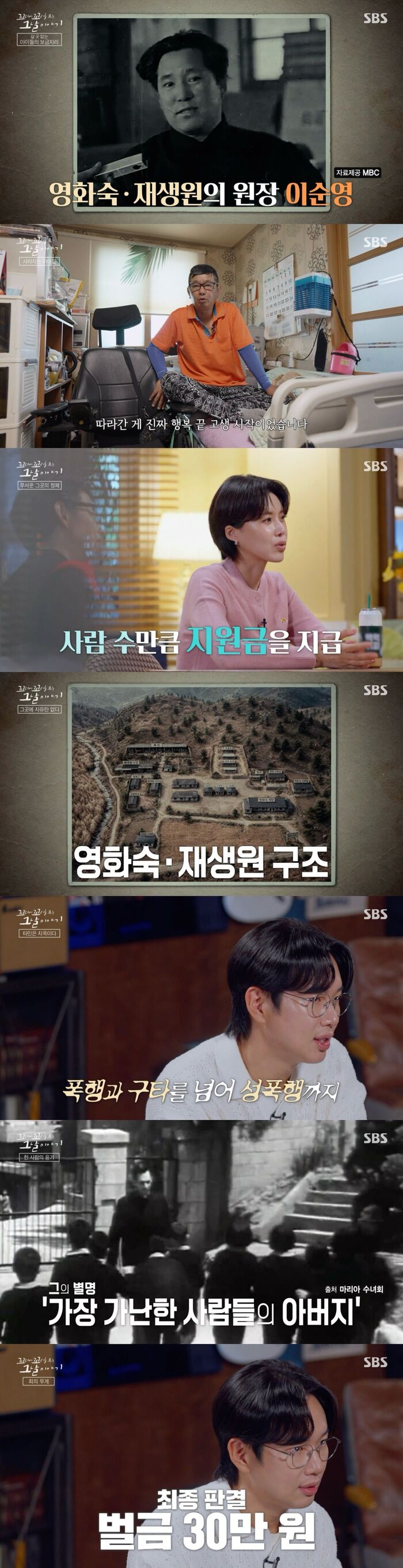
The episode of SBS's "Tails of Tales" broadcast on October 22 shed light on Busan's Yeonghwasuk and Jaesaengwon, where horrific events took place in the 1960s, under the subtitle "A Murderer's Letter – Yeonghwasuk and Jaesaengwon."
In March 2025, a letter arrived at the broadcasting station. A man named Kyung-ho, who identified himself as a prisoner serving a life sentence for murder, mentioned Busan's Yeonghwasuk and Jaesaengwon, stating, "While staying in 'that place,' I was trained in crime and committed offenses such as theft and robbery all across Busan. Everything started there."
To verify the unbelievable story in the letter, the production team tracked down people who spent their childhoods there and could not hide their shock upon hearing their stories firsthand.
The facility changed completely after its new director, Lee Soon-young, arrived at Yeonghwasuk and Jaesaengwon. It was said that after his arrival, people died daily and construction began.
Children who vanished from all over Busan were gathered there one by one. The Park Chung-hee administration at the time sought to purge vagrant children and homeless people from society under the pretext of social purification. In response, Director Lee Soon-young, who signed an outsourced custody and protection contract with Busan City for vagrants and homeless people, carried out illegal abductions for money, placing those under 18 in Yeonghwasuk and those 19 and older in Jaesaengwon.
Once ordinary citizens of Busan, they slept packed tightly like sardines on their sides in rooms piled with excrement and were watched day and night. Subjected to daily military-style control, they were also forced into hard labor amid constant violence.
Unable to eat even one proper meal a day, the children lived a subhuman existence, scavenging maggots from toilets due to starvation and even envying pig feed. Yet they could not easily escape because of collective punishment. With beatings continuing daily as if it did not matter if they died, they had no choice but to give up on escaping.
The director also made the children capture runaway peers and forced residents to bring in other inmates, creating a structure where victims became perpetrators. Consequently, the inmates repeatedly engaged in wrongful acts, even while knowing what they were doing was wrong. The children suffered severe human rights violations, including sexual assault as well as physical violence.
Friends who slept beside them one day were dead the next, and those who died from harsh abuse were buried in secret in the reed fields surrounding Yeonghwasuk and Jaesaengwon.
Father Aloysius Schwartz, an American priest known as a father to the poorest of the poor who happened to see the facility, was deeply shocked when he learned the reality of Yeonghwasuk and Jaesaengwon. He reported the truth about the place to save the children, but was ignored and even threatened in return.
However, he did not give up. He sent petitions to the Minister of Home Affairs, the Prime Minister, and even to Park Chung-hee. As a result, Director Lee Soon-young was investigated by police and detained. Yet, just six days after his arrest, Lee Soon-young was released on the grounds that he posed no flight risk.
After negotiating with Lee Soon-young, Father Aloysius received permission to care for the children. Continuing his efforts to rescue them, Busan City's consignment contract with Yeonghwasuk was canceled in 1971. It seemed that the children there would finally return to normal life.
Behind the scenes, however, Director Lee trained the children in crime. Among those led down the path of criminality was Kyung-ho. Yeonghwasuk and Jaesaengwon had become criminal academies. Director Lee also framed other children for crimes committed by someone else.
Consequently, Kyung-ho was sent to a juvenile detention center, but he evoked sorrow by saying he found freedom there. After being released from the juvenile facility, he had no choice but to return to Yeonghwasuk. Director Lee assigned Kyung-ho another duty. Drug delivery became his new assignment, and he was even made to deliver kickbacks to public officials.
Later, in 1976, Busan City canceled the corporate permit, leading to the closure of Yeonghwasuk and Jaesaengwon, and Lee Soon-young received merely a fine of 300,000 won in his final judgment. The reason was that there was insufficient evidence to prove Lee Soon-young had directly ordered the actions.
However, the wealth amassed through the inmates' forced labor and the funds illegally embezzled all reverted to Lee Soon-young's family assets. Four years after the final ruling, Lee Soon-young died of an illness in 1981.
Victims who left Yeonghwasuk were later taken to Brothers Home and subsequently sent in succession to the Samcheong Re-education Camp, unable to escape the vicious cycle of evil.
The victims suffered from panic disorder, social phobia, and claustrophobia. Furthermore, because their names were altered in the facility register upon admission to Yeonghwasuk, they were treated as unidentified persons and were even framed as spies and tortured.
After committing various crimes, Kyung-ho, then 28, happened to work at a restaurant, where he became involved in a fight and crossed a line that should never have been crossed.
Now in his 70s, Kyung-ho shared his final wish before dying: "If I am recognized as a victim of Yeonghwasuk and Jaesaengwon and receive compensation, I want to donate it to a welfare foundation that helps neighbors in need so that no one else ends up like me. And I want to excavate the bodies buried secretly around Yeonghwasuk, including the ones I buried, and return them to their families."
He added, leaving a bitter impression, "I am a violent offender and a lifer. I seek neither forgiveness nor a second chance."
Victims who lived through a lifetime of hellish trauma secured 51.1 billion won in compensation from the state and Busan City. Yet they evoked sorrow as they looked back on their irreversible lives in despair, saying, "Money is not the issue. Who am I supposed to resent and live with now?"
※ Please note: This article was translated by AI and may contain errors.