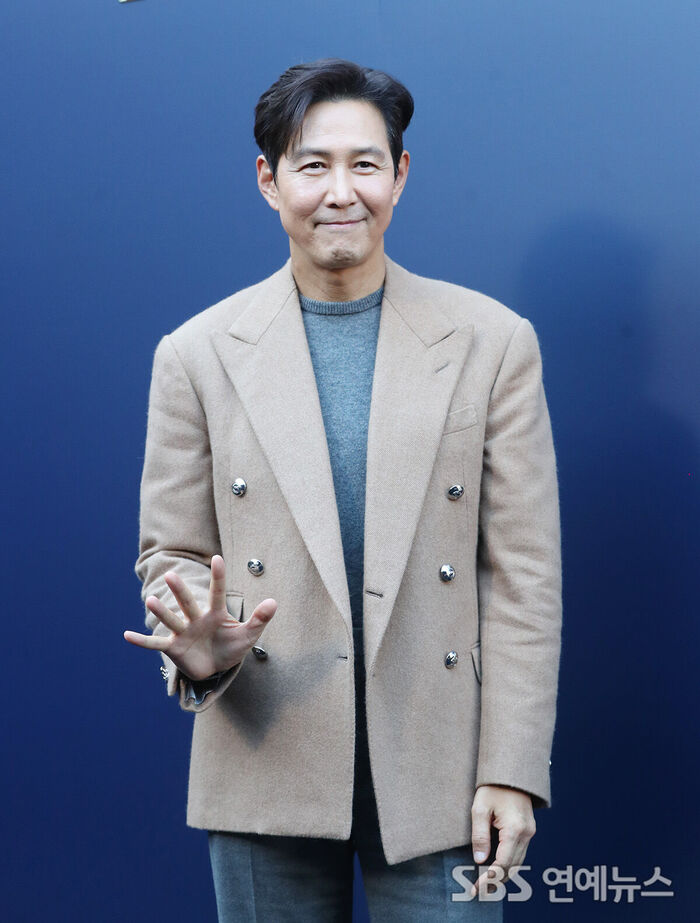
Artist Company has strongly denied allegations that actor Lee Jung-jae received preferential settlement benefits from the agency, where he serves as the largest shareholder.
On November 18, Artist Company released a detailed statement refuting a report published earlier that day by entertainment news outlet Dispatch, titled "If Sales Exceed 4 Billion Won, 10:0... Lee Jung-jae's Greedy Management as Major Shareholder."
First, addressing claims that Lee Jung-jae exploited his status as the largest shareholder to secure a 9-to-1 settlement ratio and a profit distribution cap of 4 billion won, the agency stated, "Based on the fact that there is a profit distribution cap in the settlement contract, the report made it appear as though he used his status as the largest shareholder to grant special benefits solely to himself." The agency explained, "A fellow actor who served as an internal director alongside actor Lee Jung-jae also received no separate executive compensation, and identical settlement contract terms were applied to both actors." The fellow internal director mentioned by Artist Company refers to Jung Woo-sung, who recently departed the agency.
Furthermore, regarding Dispatch's report that Lee Jung-jae earned 20 billion won in appearance fees for his contracts on Seasons 2 and 3 of "Squid Game" while the company received only 400 million won due to the profit distribution cap, the agency clarified, "Contracts and overseas agency operations related to Seasons 2 and 3 of 'Squid Game' were handled by American agency CAA, and the corresponding fees were paid to CAA as the contracting entity. Separate agency fees were also paid for other overseas work conducted through CAA. On the other hand, although our agency did not directly execute the contracts or overseas agency duties for this project, we still received a profit distribution in accordance with the existing settlement contract." The agency added, "The appropriateness of the profit distribution cap must be evaluated comprehensively—not solely based on the additional revenue the company could have received, but also taking into account who actually performed the work, who incurred the expenses, and the profits the company had already received."

Regarding the criticism that Artist Company, which has been dealing with an operating deficit, could have earned an additional 1.6 billion won instead of just 400 million won had there been no profit cap, the agency responded, "That calculation is based on the mere assumption that only the cap clause would be eliminated from the settlement contract while all other terms remained untouched." The agency continued, "Management contracts are finalized after comprehensively considering an actor's performance, the duration of the exclusive contract, settlement ratios, company investments and cost burdens, and the economic value of maintaining the contract. In particular, given that actor Lee Jung-jae contributes the most to the company's sales and revenue among all affiliated actors, the presence of a cap clause alone cannot be deemed preferential treatment. When establishing these contract terms, the company considered the appropriateness of related-party transactions and reviewed the opinions of external auditors."
Artist Company also actively clarified suspicions of a conflict of interest regarding real estate matters. The agency stated, "The report portrayed our company as having incurred unnecessary rental expenses by operating multiple offices. However, when the stock purchase agreement for RaemongRaein was executed, the existing directors and auditor had agreed to submit their resignations, but failed to do so, causing disruptions to the takeover of management control and business handover." The agency explained, "This led to legal disputes, including filing a lawsuit for damages against the previous majority shareholder. In that process, we inevitably had to secure a separate office to ensure normal business activities and operations. Operating multiple offices and incurring related expenses was not a decision made for actor Lee Jung-jae's personal benefit, but an unavoidable measure resulting from the failure to fulfill the resignation obligations stipulated in the stock purchase agreement."

Addressing allegations surrounding the cosmetics business, the agency stated, "The report depicted the agreement with Vena Beauty as a transaction designed to transfer the company's profits to actor Lee Jung-jae personally. However, actor Lee Jung-jae spent an extended period preparing the cosmetics brand and product development, established Vena Beauty, and directly bore the associated development costs. In addition to contributing his portrait rights, name rights, global recognition, and business network, he invested substantial time and effort into the actual business operations."
The agency added, "Considering that actor Lee Jung-jae's typical commercial model fees amount to hundreds of millions of won, an annual minimum guarantee (MG) of 30 million won is an extremely modest amount. Lee Jung-jae's side initially even considered waiving the MG entirely for the company's benefit, but it was set at the minimum amount to account for tax issues related to providing rights free of charge."
Concerning the series of allegations, Artist Company emphasized, "It is unreasonable to connect every one of the company's business management decisions to actor Lee Jung-jae's pursuit of personal gain. The report lists distinctly different matters—such as the relocation of the head office, entry into the cosmetics business, the sale of business divisions, stock price declines, and operating losses—and ties them all to a single conclusion of personal profit-seeking by actor Lee Jung-jae. However, each transaction must be evaluated individually based on its execution timing, business purpose, transaction counterparties, contract conditions, and management necessity."
The agency concluded, "We respect legitimate media coverage and criticism. However, media criticism must also be predicated on accurate facts, sufficient verification, and a fair opportunity for rebuttal. Moving forward, we will continue to protect the interests of the company and our shareholders while offering responsible explanations grounded in precise facts."
(SBS Entertainment News | Kim Ji-hye)